

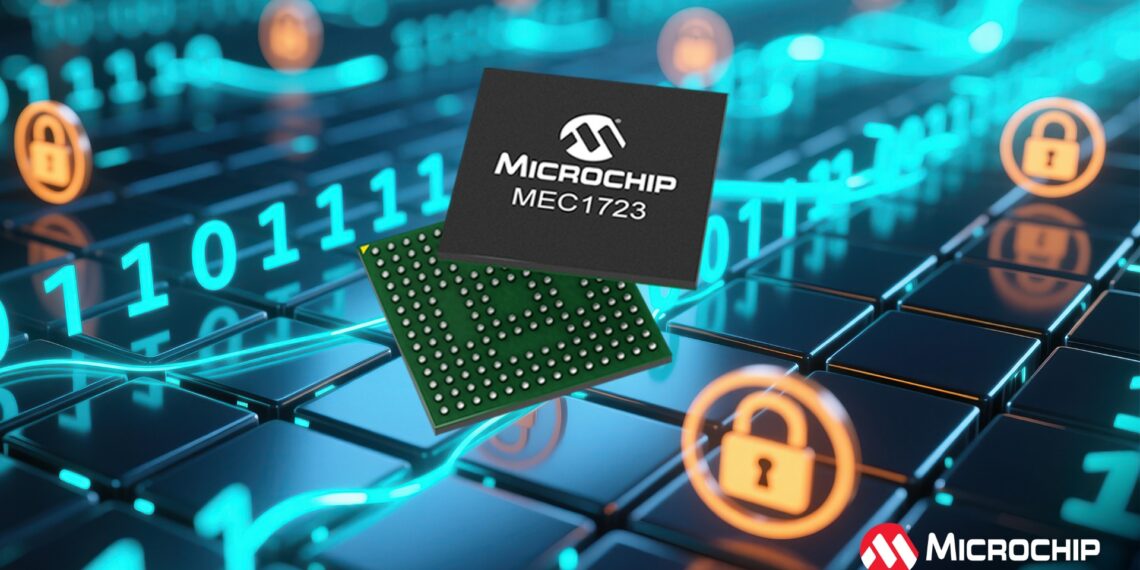
Microchip Technology (Nasdaq: MCHP) has unveiled custom firmware for its MEC1723 Embedded Controller (EC), designed specifically to support NVIDIA DGX Spark personal AI supercomputers. The firmware is aimed at optimizing system management, security, and power efficiency for AI workloads running on NVIDIA’s DGX platform. By focusing on firmware innovation, Microchip seeks to improve both performance and reliability in high-performance computing environments.
Embedded controllers play a critical role in managing system-level operations such as power sequencing, alerts, and energy regulation. The MEC1723 firmware takes these capabilities further by incorporating secure firmware authentication, advanced system control, and optimized power management, all tailored to meet the demands of AI computing.
Key features of the MEC1723 firmware include secure firmware authentication, where NVIDIA digitally signs and validates the firmware to ensure platform integrity. It also establishes a Root of Trust for system boot through Elliptic Curve Cryptography (ECC-P384), providing cryptographic verification that underpins secure system start-up. The firmware further enhances power management by handling battery charging, system alerts, and power-state transitions to maximize energy efficiency.
In addition, the firmware oversees key scan and keypad operations for reliable user input, supports NVIDIA DGX’s packet command format for advanced host interface communication, and integrates EMI and SRAM interfaces to improve overall system performance.
“The collaboration between Microchip and NVIDIA helps deliver secure, tailored firmware solutions that address the complex needs of modern computing platforms,” said Nuri Dagdeviren, Corporate Vice President of Microchip Technology’s Secure Computing Group. “Our MEC1723 firmware is customized to provide reliable operation and advanced functionality for NVIDIA DGX architecture, supporting the evolving requirements of client computing.”
Microchip’s MEC embedded controllers are designed for notebooks, desktops, and industrial systems, offering advanced system management, robust security features, and efficient power handling. With this firmware, the MEC1723 emerges as a crucial enabler for next-generation AI and high-performance computing applications across both enterprise and consumer markets.