

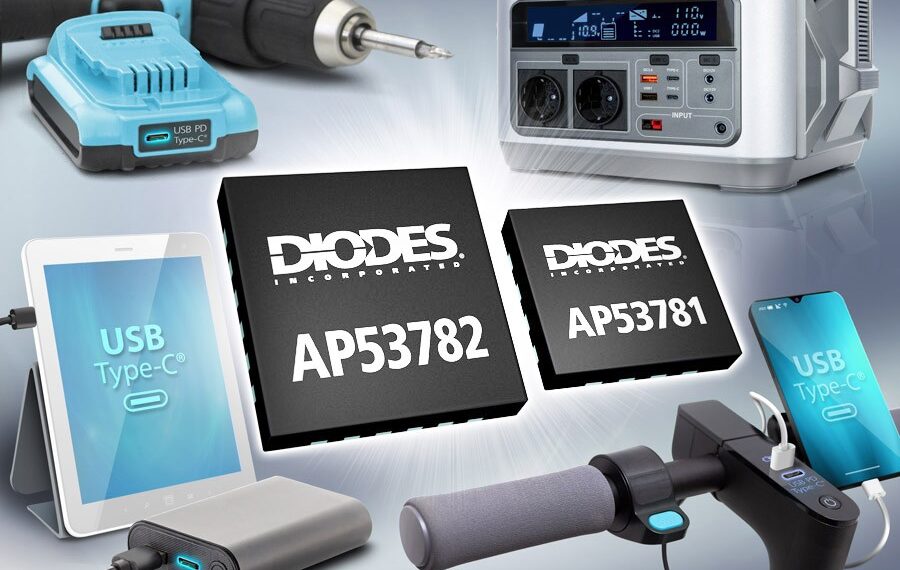
Diodes Incorporated has expanded its power management portfolio with the introduction of two new 28V USB Type-C Power Delivery dual-role controllers aimed at battery-powered portable devices. Announced on January 14, 2026, the AP53781 and AP53782 controllers are designed to manage both power requests and power output, supporting charging as well as power release from internal batteries.
The new devices comply with the latest USB Power Delivery 3.1 extended power range (EPR) specification, enabling power delivery of up to 140W. This capability allows a single USB Type-C port to function as both a power sink and a power source, reducing the need for multiple chargers, adapters, or cables. Target applications include power banks, power tools, e-bikes, and portable displays equipped with USB Type-C connectors.
Both controllers feature integrated firmware that automatically negotiates power roles with PD3.1-compliant chargers or connected devices. They can dynamically operate as either a sink or a source, depending on system requirements. A dead-battery mode is also supported, allowing the controllers to act as a sink when the system battery is depleted until an external power source is connected. In addition, 34V-tolerant configuration channel (CC) pins provide protection against accidental shorts to the high-voltage VBUS line, enhancing system robustness.
The AP53781 is designed for cost-sensitive and space-constrained designs. It includes preloaded power data object (PDO) and request data object (RDO) profiles that simplify source and sink role selection. Eight source profiles and multiple fixed voltage and current options can be selected using external resistors, eliminating the need for a dedicated microcontroller and reducing overall design complexity.
For applications requiring greater flexibility, the AP53782 integrates an I2C interface that enables direct communication with a host microcontroller. This allows designers to implement more advanced and adaptive power-management schemes, including dynamic profile selection and additional system-level control.
The AP53781 is offered in a compact 3mm × 3mm W-QFN3030-16 package, while the AP53782 is housed in a 4mm × 4mm W-QFN4040-24 package. Both devices operate across a wide junction temperature range of –40°C to +125°C, supporting use in demanding environments. Pricing is set at $0.57 for the AP53781 and $0.59 for the AP53782 in 1,000-unit quantities.