

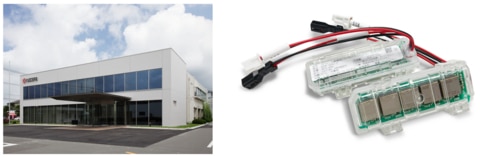
Kyocera Corporation and Maxell, Ltd. have begun test operations of industrial robots powered by all-solid-state battery power modules at Kyocera’s Kagoshima Sendai Plant in Japan. The trials, which started in December 2025, mark a step toward reducing maintenance requirements and environmental impact in semiconductor manufacturing environments.
The test deployment involves installing power modules that incorporate Maxell’s PSB401010H all-solid-state battery in industrial robots and their controllers. The Kagoshima Sendai Plant is one of Kyocera’s key production sites for semiconductor ceramic packages, making it a suitable environment for evaluating advanced battery technologies under demanding industrial conditions.
Maxell’s all-solid-state batteries are housed in ceramic packages manufactured by Kyocera. These ceramic enclosures offer high heat resistance and hermetic sealing, contributing to battery reliability that exceeds conventional designs using liquid electrolytes. According to the companies, this combination enhances operational stability in harsh factory environments where temperature fluctuations and long operating hours are common.
In many industrial automation systems, robots rely on power modules equipped with primary, non-rechargeable batteries to maintain memory retention during power outages and to support real-time clock functions. These primary batteries typically require replacement every one to two years, generating recurring maintenance work and industrial waste.
By replacing primary batteries with the rechargeable PSB401010H all-solid-state battery, the power modules are expected to deliver a service life of more than 10 years. This extended lifespan could significantly reduce battery replacements, lower waste generation, and maintain high safety standards in manufacturing settings.
Based on the results of the test operations, Kyocera will assess the broader introduction of technologies that further reduce maintenance workloads and environmental impact across its factories. Maxell, meanwhile, plans to continue advancing all-solid-state battery development along four key axes: high reliability, high heat resistance, high output, and large power supply capacity.
The two companies also stated they will deepen cooperation in all-solid-state battery technologies, targeting both industrial applications and new use cases where conventional batteries are unsuitable.