

Electric vehicle manufacturer Faraday Future has formally entered the robotics sector, introducing three embodied artificial intelligence robot product lines as it seeks to diversify its business and capitalise on growing demand for intelligent automation.
The California-based company unveiled the robots at the annual National Automobile Dealers Association (NADA) Show in Las Vegas, positioning the move as a strategic extension of its long-term vision around AI-driven mobility and human–machine interaction. The launch marks the establishment of a new subsidiary, FF EAI-Robotics Inc., headquartered in California, and signals Faraday Future’s ambition to become one of the first U.S. companies to deliver both humanoid and quadruped robots at scale.
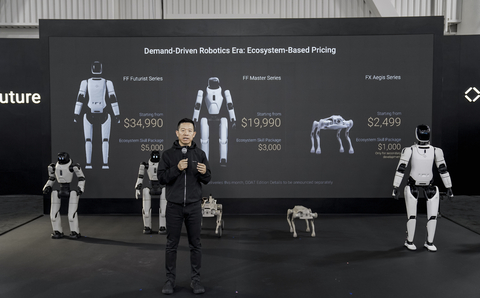
The three products announced include the FF Futurist, a full-size professional humanoid robot; the FF Master, an athletic, consumer-focused humanoid robot; and FX Aegis, a quadruped robot designed for security and companionship. Sales and non-binding paid pre-orders for all three models opened on the same day, with the first batch of deliveries targeted for the end of February. A mobile manipulator robot series is planned for launch in the second quarter of the year.
Faraday Future also disclosed pricing for the new robotics lineup. The FF Futurist series will start at USD 34,990, the FF Master series at USD 19,990, and the FX Aegis series at USD 2,499. Each product is offered alongside an optional “Ecosystem Skill Package,” priced between USD 1,000 and USD 5,000 depending on the model, reflecting the company’s ecosystem-based pricing strategy. The company said it is also evaluating financing, leasing, and rental options to broaden market access.
According to Faraday Future, more than 1,200 EAI robotics units are currently covered by non-binding, non-refundable B2B deposits, an early indicator of commercial interest as the company prepares for production. The robotics division has entered the production preparation phase, while scenario-specific customization, testing, and data training are being conducted in parallel to accelerate delivery timelines.
The launch is built around what Faraday Future describes as its “Three-in-One” EAI Robotics Ecosystem strategy, comprising the EAI device, an open-source EAI brain and platform, and a decentralised data factory. The company says this approach is designed to move the industry toward what it calls a “Demand-Driven Robotics Era,” where hardware, software, and data evolve together through real-world deployment and user co-creation.
The robotics push complements Faraday Future’s existing electric vehicle operations, forming what the company describes as a dual-track growth model anchored in both EAI vehicles and EAI robotics. Executives said the strategy builds on the company’s long-standing “vehicle-as-a-robot” concept, first proposed nearly a decade ago, and leverages shared capabilities across AI software, computing platforms, manufacturing, and supply chains.
Faraday Future’s leadership argues that the robotics business offers structural advantages compared with traditional automotive development, including lower capital intensity, faster product cycles, and the potential for earlier positive operating cash flow. The company also believes that robotics sales channels could increasingly overlap with automotive dealerships, particularly as intelligent systems become more integrated into daily life and work environments.
At the NADA Show, Faraday Future showcased its updated FF Par partner model to dealers and hosted a recruitment event for preliminary sales partners for its robotics products. The FF Par framework aims to shift dealers from one-time product sales toward long-term participation in user operations and intelligent terminal ecosystems, allowing partners to share recurring value without traditional inventory and pricing risks.
The company also announced a non-binding letter of intent with AIxC to explore potential collaboration opportunities in the Web3 space, underscoring its interest in decentralised data and digital asset frameworks as part of its broader ecosystem strategy.
Commenting on the launch, founder and global co-CEO YT Jia described the robotics initiative as a pivotal moment for the company, stating that embodied AI robots working alongside humans could help reshape productivity models through deeper human–machine collaboration.
Industry observers note that the timing aligns with rapid advances in large language models, AI computing power, battery technology, and autonomous systems, which are collectively accelerating the commercial viability of embodied robotics. As competition intensifies globally, Faraday Future’s success will depend on its ability to execute deliveries, scale manufacturing, and differentiate its ecosystem approach in a crowded and fast-evolving market.
Looking ahead, Faraday Future has projected that long-term global robot ownership could eventually reach tens of billions of units, far exceeding today’s global automobile fleet.