

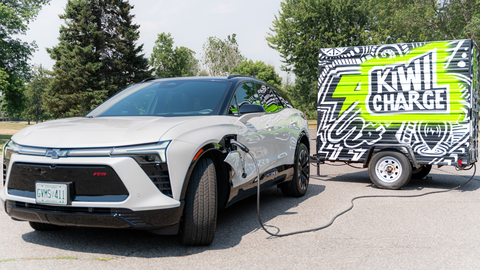
Kiwi Charge has launched a new autonomous electric vehicle (EV) charging project backed by government and industry partners, marking a fresh push to address gaps in urban charging infrastructure. The robotics and artificial intelligence startup said the initiative is supported by a total investment of $1.7 million, aimed at accelerating the development of mobile, autonomous EV charging solutions.
The project is backed by the Government of Ontario through the Ontario Vehicle Innovation Network (OVIN), with additional support from General Motors Canada and Pfaff Automotive. Funding includes a $500,000 grant from the OVIN R&D Partnership Fund, alongside $1.2 million contributed by industry partners. Kiwi Charge said the investment will enable faster prototyping, testing, and deployment of its autonomous charging technology.
As part of the project launch, Kiwi Charge will unveil the latest version of its autonomous EV charging robot at the Canadian International AutoShow, scheduled from February 13 to 22. The system will be showcased alongside Project Arrow, Canada’s first zero-emissions concept vehicle developed by the Automotive Parts Manufacturers’ Association (APMA). The public demonstration is intended to highlight how mobile charging systems could complement next-generation vehicle platforms.
The startup is targeting a persistent challenge in EV adoption: access to charging in dense urban environments. In many cities, a significant share of EV owners live in multi-tenant residential buildings, where installing fixed charging stations often requires expensive electrical upgrades and structural modifications. Kiwi Charge estimates that around 30% of EV owners fall into this category, limiting their ability to charge conveniently at home.
Kiwi Charge’s approach replaces hardwired chargers with compact, autonomous units that can navigate parking garages and deliver power on demand. The system combines robotic mobility, AI-driven fleet intelligence, and electrification in a single platform. According to the company, the chargers can dynamically serve multiple vehicles without rewiring, helping property owners avoid major capital expenditures while improving charger utilization.
The technology is designed to operate in both public and private settings, including older condominiums, rental buildings, and commercial facilities. By removing the need for fixed infrastructure, Kiwi Charge aims to enable faster electrification of existing buildings while reducing strain on local power grids. The company said this aligns with Ontario’s broader climate, housing, and innovation objectives.
Beyond residential use cases, Kiwi Charge is also developing solutions for automotive dealerships. The company is working on a manual mobile charging unit designed for use on dealership lots, where vehicles frequently need to be repositioned and kept charged throughout the day. The system is intended to support smoother operations, higher inventory turnover, and more efficient EV fleet management.
Kiwi Charge said the new funding will allow it to rapidly prototype and test its flagship autonomous charging units, shortening development timelines that would otherwise require significantly more capital. The investment will also support pilot projects with real estate partners and automotive dealers, as well as talent hiring and deeper engagement with Ontario’s growing AI ecosystem.
“This project is about more than just EV charging,” said Abdel Ali, CEO of Kiwi Charge. He said the initiative focuses on reshaping urban infrastructure through robotics and AI, while enabling buildings to move away from rigid, outdated charging models. Ali added that provincial and industry backing provides credibility and momentum to scale the technology.
General Motors Canada said its involvement reflects a broader commitment to innovation in sustainable mobility. Regan Dixon, Senior Manager at GM’s Canadian Technical Centres, said the company aims to support startups that can improve the EV ownership experience and encourage wider adoption.
Provincial officials positioned the project as part of Ontario’s strategy to strengthen its role in the global EV ecosystem. Raed Kadri, Head of OVIN, said supporting homegrown companies helps move next-generation technologies from concept to market while creating economic opportunities.
Claudia Krywiak, President and CEO of the Ontario Centre of Innovation, said Kiwi Charge demonstrates how local innovation can address major barriers to EV adoption. She added that applying robotics and AI to charging infrastructure could accelerate the transition to cleaner mobility while reinforcing Ontario’s leadership in EV and battery technologies.
With pilot deployments planned and public demonstrations underway, Kiwi Charge is positioning its autonomous charging systems as a flexible alternative to traditional infrastructure, at a time when demand for scalable EV solutions continues to grow.