

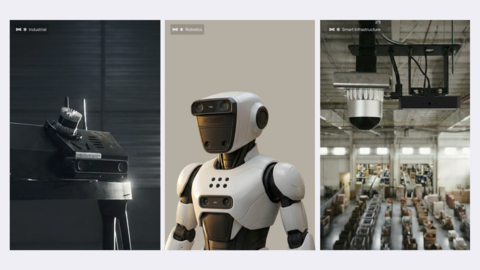
Ouster has completed the acquisition of StereoLabs, marking a significant step in the convergence of sensing and perception technologies for what the industry increasingly refers to as Physical AI. The transaction, which closed on February 4, 2026, brings together Ouster’s digital lidar portfolio with StereoLabs’ stereo vision and AI perception software to form a unified sensing and perception platform.
The deal positions Ouster, listed on Nasdaq under the ticker OUST, as a single-source provider of core technologies required for autonomous and intelligent machines. The combined platform integrates digital lidar, cameras, AI compute, sensor fusion, perception software, and AI models, targeting applications across robotics, industrial automation, and smart infrastructure.
StereoLabs, founded in 2010, is best known for its ZED stereo camera lineup and 3D vision software. The company has shipped more than 90,000 cameras globally and serves over 10,000 customers. Its developer community spans thousands of active users building industrial-grade perception systems. StereoLabs’ solutions are widely used in robotics, automation, and infrastructure monitoring, where real-time spatial understanding is critical.
Under the terms of the acquisition, StereoLabs will operate as a wholly owned subsidiary of Ouster. The existing leadership team—co-founders Cecile Schmollgruber, Edwin Azzam, and Olivier Braun—will continue to lead the business. Ouster said it plans to maintain continuity across StereoLabs’ product roadmap, customer relationships, and developer ecosystem.
Industry momentum has increasingly shifted toward sensor fusion, rather than reliance on a single modality. Vision systems provide rich contextual data, while lidar delivers precise range and depth information. The integration of both is seen as essential for machines operating in dynamic, unstructured environments.
“The future of autonomy isn’t about choosing between vision or lidar, it’s about unifying them,” said Schmollgruber. She said the combination of StereoLabs’ AI vision and Ouster’s digital lidar would directly address customer demand for integrated perception systems capable of sensing, reasoning, and acting in the physical world.
Ouster CEO Angus Pacala described the acquisition as a strategic extension of the company’s sensing roadmap. He said StereoLabs’ technology and customer base complement Ouster’s push to become an end-to-end platform provider as industries move beyond basic automation toward more intelligent, adaptive systems.
From a product perspective, the integration is intended to simplify development for customers. Ouster plans to deliver synchronized and pre-calibrated lidar and stereo camera data out of the box. By combining high-density visual data with lidar’s accuracy and range, the company aims to improve object manipulation, navigation, and safety, while reducing integration complexity and cost.
The acquisition also strengthens Ouster’s software capabilities. Both companies have invested heavily in AI training and perception models. Ouster said pooling those investments would accelerate software development and expand functionality for customers deploying Physical AI systems at scale.
The transaction broadens Ouster’s addressable market. In addition to its existing lidar-driven applications, the company expects to unlock new opportunities in humanoid robotics, industrial automation, and visual inspection. The expanded portfolio allows Ouster to address customers looking for complete perception stacks rather than individual components.
Financially, the deal adds a profitable business to Ouster’s portfolio. StereoLabs reported unaudited revenue of approximately $16 million in 2025 and was EBITDA positive. Ouster said this strengthens its balance sheet and supports its path toward sustained profitability.
The acquisition was completed using a mix of approximately $35 million in cash and 1.8 million shares of Ouster stock, with 0.7 million shares subject to a four-year release schedule. Ouster will begin consolidating StereoLabs’ financial results in the first quarter of fiscal 2026.