

Microchip Technology has expanded its edge artificial intelligence (AI) portfolio with production-ready, full-stack solutions designed to simplify and accelerate the deployment of machine learning (ML) models directly at the edge. The move strengthens the company’s positioning in industrial, automotive, data center and consumer IoT markets, where real-time inferencing and low-latency decision-making are becoming operational requirements.
As AI adoption matures, enterprises are increasingly shifting ML workloads from centralized cloud environments to edge devices located closer to sensors and actuators. These devices collect data, control motors, trigger alarms and manage system responses in real time. By processing data locally, edge AI reduces latency, enhances privacy and lowers reliance on constant cloud connectivity.
Microchip’s expanded offering integrates silicon, software, tools and production-ready application frameworks into a unified development approach. The company’s microcontrollers (MCUs), microprocessors (MPUs) and FPGAs are positioned not only as embedded components but as scalable platforms capable of supporting secure and efficient AI deployment.
“AI at the edge is no longer experimental—it’s expected, because of its many advantages over cloud implementations,” said Mark Reiten, Corporate Vice President of Microchip’s Edge AI business unit. He noted that the company established its dedicated Edge AI division to combine its compute portfolio with optimized ML models, model acceleration capabilities and development tools. The latest application solutions, he added, are designed to shorten development cycles and support deployment in demanding environments.
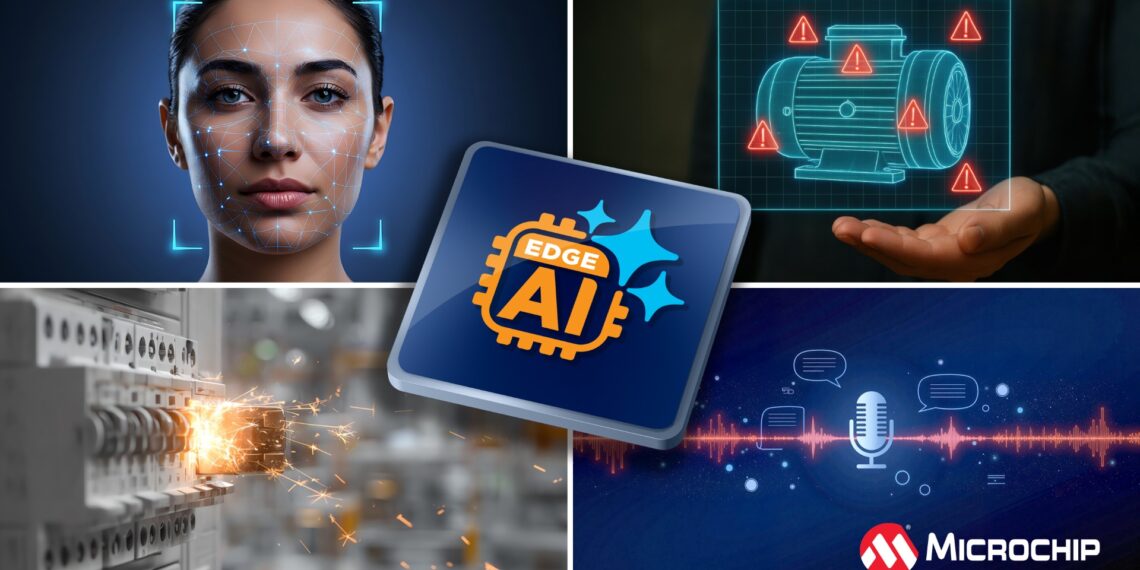
The new full-stack application solutions include pre-trained, deployable ML models paired with adaptable application code. Developers can modify and enhance these frameworks using Microchip’s embedded software ecosystem or partner tools. Initial solutions focus on AI-based detection and classification of electrical arc faults, predictive maintenance through condition monitoring, facial recognition with liveness detection for secure identity verification, and keyword spotting for voice-based command interfaces across industrial and automotive systems.
To streamline development, Microchip is leveraging its established design platforms. The MPLAB X Integrated Development Environment (IDE), combined with the MPLAB Harmony framework and MPLAB ML Development Suite plug-in, provides a scalable path from proof-of-concept to production. Engineers can begin development on 8-bit MCUs and migrate to higher-performance 16-bit or 32-bit devices as application complexity increases, maintaining continuity across the toolchain.
For FPGA-based workloads, the company’s VectorBlox Accelerator SDK 2.0 supports AI/ML inference for vision processing, human-machine interfaces and sensor analytics. The platform also enables model training, simulation and optimization within a consistent workflow, addressing performance and efficiency requirements at the edge.
Microchip’s approach extends beyond processors. The company is supporting system-level integration with complementary components such as PCIe connectivity devices and high-density power modules for industrial automation and data center deployments. Reference designs, including motor control systems using dsPIC Digital Signal Controllers, further support real-time data extraction and edge AI pipelines. Additional enablement solutions address applications such as smart e-metering, object detection and motion surveillance.
Industry analysts have identified embedded edge AI as a major growth area. In its October 2025 market report, IoT Analytics cited the integration of AI capabilities directly into MCUs as one of the top industry trends, noting benefits such as reduced latency, enhanced data privacy and decreased dependency on cloud infrastructure. Edge ecosystems increasingly demand support for both software-based acceleration and integrated hardware acceleration across diverse memory configurations.
Microchip said it is actively collaborating with customers on full-stack application deployments and working with ecosystem partners to expand deployment-ready software options. As AI-driven intelligence becomes embedded into core system design, the company’s strategy reflects a broader shift in the semiconductor industry toward integrated, production-focused edge AI platforms.