

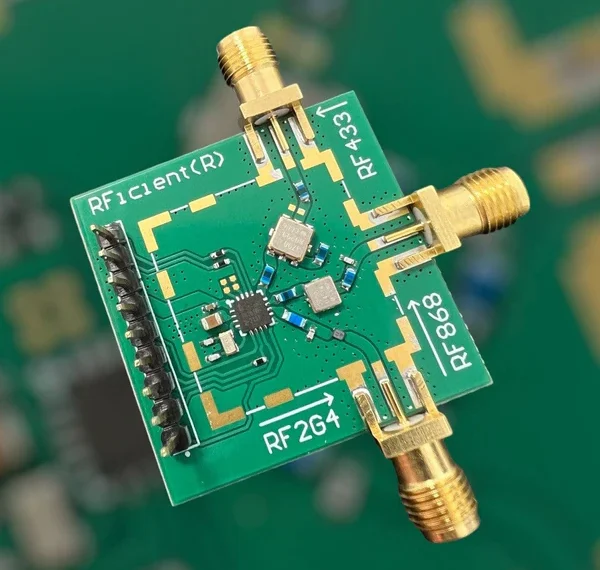
LZE GmbH has introduced RFicient, an ultra-low-power wake-up receiver technology developed by the Fraunhofer Institute for Integrated Circuits IIS, to the broader industrial market as a standard chip. The move makes the technology available for the first time for close-to-production applications, offering developers a solution for energy-efficient Internet of Things (IoT) devices designed for long operational lifetimes.
The new chip, designated RFicient-IC (FH101RF), is part of LZE’s technology transfer portfolio, which focuses on bringing research innovations into commercial applications. By providing the technology as a standard component that can be ordered in volume, the company aims to simplify integration into industrial product development and shorten the path from research to deployable solutions.
Wireless IoT systems often face a fundamental challenge: maintaining constant radio connectivity while minimizing energy consumption. RFicient addresses this challenge by enabling continuous radio channel monitoring with extremely low power usage. The wake-up receiver operates with a current consumption of less than 3.5 microamps and can respond to incoming wake-up signals in approximately 32 milliseconds.
The technology supports multiple license-free frequency bands, including 433 MHz, 868/915 MHz, and 2.4 GHz, making it suitable for a range of wireless communication environments. It also enables selective wake-up using a 16-bit identification code, allowing devices to remain in low-power states until specifically addressed. According to developers, this capability enables IoT products to function for years on a single battery while maintaining reliable connectivity and response times.
LZE positions the RFicient®-IC as a bridge between laboratory research and industrial deployment. By offering the chip as a standard component, manufacturers can integrate the technology into product prototypes and development platforms without the need for extensive customization.
“Our task is to turn research results into market-ready technologies,” said Dr. Christian Forster, CEO of LZE GmbH. “RFicient demonstrates how energy-efficient wireless solutions can be both reliable and scalable. Making RFicient-IC available as a standard product allows companies to source the technology in volume and accelerate the transition from concept to product, based on Fraunhofer IIS research.”
Researchers involved in the development highlight the potential impact on battery-powered systems. Thomas Thönes, Group Leader for RFIC Design at Fraunhofer IIS, noted that the technology enables wireless systems to remain continuously responsive while consuming minimal power. According to Thönes, the ability to detect wake-up signals with less than 3.5 microamps of consumption opens new opportunities for sustainable and low-maintenance IoT devices.
Potential applications for the RFicient technology include smart home systems, building automation, industrial monitoring, wireless sensor networks, and logistics or asset tracking solutions. In these environments, devices are often expected to operate for extended periods without battery replacement while remaining accessible through wireless communication.