

Kioxia Corporation has developed a new class of solid-state drives (SSDs) designed to support GPU-initiated AI workloads, as demand grows for faster and more efficient data access in artificial intelligence and high-performance computing environments.
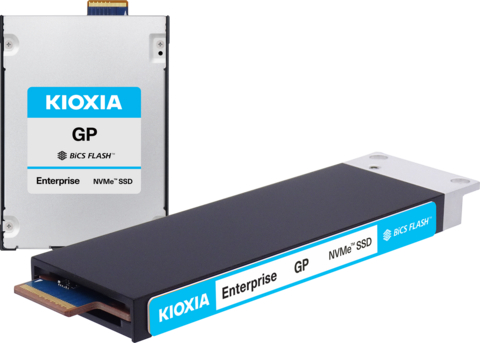
The company’s latest offering, the KIOXIA GP Series, is a Super High IOPS SSD engineered to allow GPUs to directly access high-speed flash memory, effectively extending available memory beyond traditional High Bandwidth Memory (HBM). The new architecture aims to improve data throughput and expand GPU-accessible memory capacity, enabling faster processing of large-scale AI workloads. Evaluation samples are expected to be available to select customers by the end of 2026.
The development aligns with NVIDIA’s Storage-Next initiative, which addresses a shift from compute-intensive to data-intensive AI workloads. As AI models grow in complexity, with trillions of parameters and significantly larger context windows, the demand for memory capacity and bandwidth has increased substantially. Storage-Next promotes the integration of high-performance SSDs into the GPU memory hierarchy, enabling more efficient data movement and improved GPU utilization.
Kioxia’s GP Series leverages its XL-FLASH storage-class memory technology to deliver low latency, high input/output operations per second (IOPS), and finer-grained data access compared to conventional SSDs. The design also focuses on reducing power consumption per operation, a critical factor in large-scale AI deployments.
According to Makoto Hamada, Senior Director of Kioxia’s SSD Division, the company is aligning its product roadmap with emerging AI infrastructure requirements. He noted that purpose-built storage solutions will play a key role in enabling GPU-accessible memory and shaping future AI system architectures.
In parallel, Kioxia is also advancing its CM9 Series PCIe 5.0 E3.S SSDs, which are designed to support large-scale AI inference workloads. These drives offer capacities of up to 25.6 TB and are engineered to handle intensive data demands such as key-value (KV) cache expansion, a growing requirement in modern AI models.