

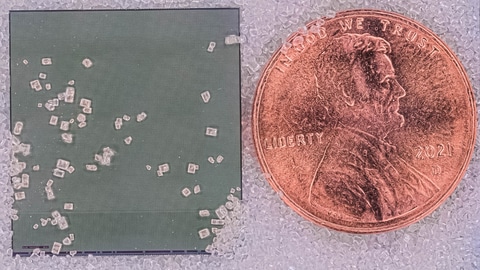
Argonne National Laboratory has unveiled a new chip technology designed to enable real-time data processing and compression for advanced scientific experiments, addressing one of the most pressing challenges in modern research: the overwhelming volume of data generated by high-performance detectors.
Developed by researchers at the U.S. Department of Energy facility, the chip integrates data processing capabilities directly into detector systems used in applications such as X-ray imaging. These detectors, including those deployed at the Advanced Photon Source, generate massive streams of data when X-rays or electrons interact with materials under study. Traditionally, this data must be transmitted to external computing systems for analysis, often creating bottlenecks that slow down experiments.
The newly developed chip addresses this limitation by embedding a compact matrix-math processor directly within the detector hardware. Instead of transmitting raw data from every pixel, the chip processes and compresses the information at the source, extracting key features and converting them into a consistent, compact data stream. This enables real-time analysis while significantly reducing the burden on downstream computing systems.
According to the research team, the technology can compress data volumes by a factor of 100 to 200 while operating at speeds of up to one million frames per second. This level of performance not only reduces the amount of data that needs to be transferred but also lowers power consumption and simplifies system architecture by minimizing the need for extensive cabling and external processing infrastructure.
Antonino Miceli, a physicist affiliated with Argonne and the University of Chicago, noted that the goal of the project is to bring computing closer to where data is generated. By embedding advanced mathematical processing within the detector itself, the chip allows scientists to retain essential information while discarding redundant data in real time.
The implications for scientific research are significant. With faster data processing, researchers can analyze results instantly and make adjustments during experiments, improving efficiency and accelerating discovery cycles. This is particularly valuable in high-demand research environments where access to experimental facilities is limited and time-sensitive.
The Argonne team is now working to transition the chip from prototype to large-scale fabrication, with the aim of deploying it in real-world experimental settings. If successfully commercialized, the technology could play a key role in enabling next-generation scientific instrumentation, supporting more efficient, scalable, and data-driven research across disciplines.