

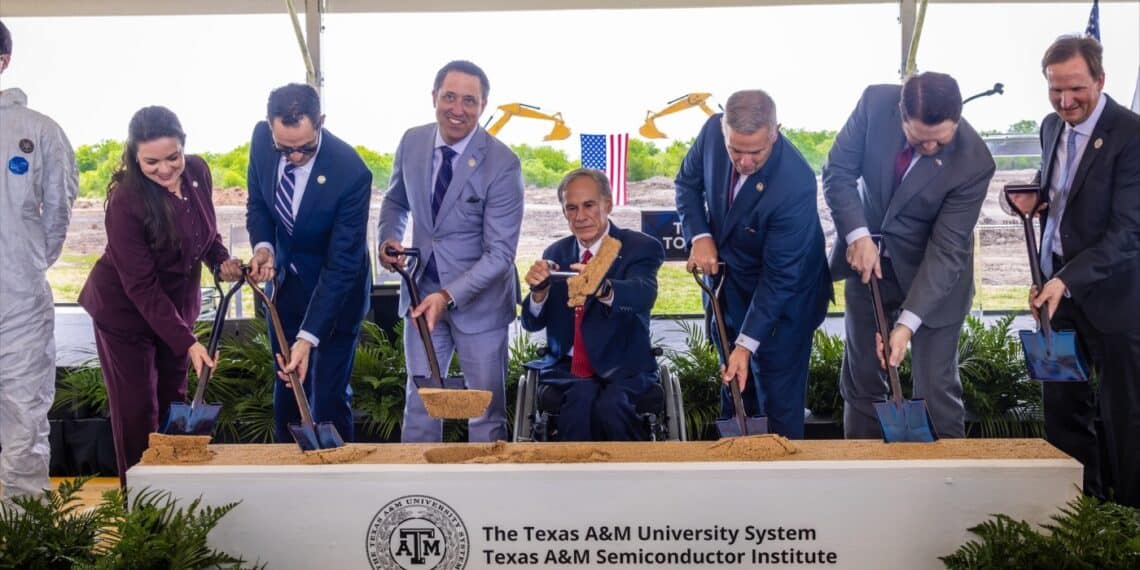
Texas Governor Greg Abbott participated in the groundbreaking ceremony for the new Texas A&M Semiconductor Institute, underscoring the state’s strategic push to strengthen its leadership in semiconductor innovation and manufacturing.
Speaking at the event, Abbott emphasized the growing importance of domestic chip production, stating that both Texas and the United States must work toward achieving microchip independence. He described the institute as a significant step in advancing that goal, highlighting Texas A&M University’s expanding role in driving research and innovation.
The facility, located on the Texas A&M–RELLIS campus, is expected to serve as a critical hub for next-generation semiconductor research, workforce development, and industry collaboration. The initiative aligns with broader efforts to reinforce the United States’ semiconductor ecosystem amid increasing global competition and supply chain concerns.
Abbott noted that Texas has long played a foundational role in the semiconductor industry, describing it as the birthplace of the modern microchip. He also pointed out that the state has maintained the top position in semiconductor exports for 15 consecutive years, reflecting its strong manufacturing and design capabilities.
The new institute is designed to further enhance these capabilities by fostering partnerships between academia, industry, and government. It aims to support disruptive research and accelerate the development of advanced technologies while also preparing a skilled workforce to meet future industry demands.
The Governor also highlighted the role of policy in supporting the sector’s growth. He referenced the Texas CHIPS Act, signed into law in 2023, which established initiatives such as the Texas Semiconductor Innovation Fund and the Texas Semiconductor Innovation Consortium. These programs are intended to attract investment, support expansion by semiconductor companies, and leverage the expertise of higher education institutions across the state.
The groundbreaking ceremony was attended by several state and academic leaders, including Representative Paul Dyson, Texas A&M University System Chancellor Glenn Hegar, Regent Jay Graham, Vice Chancellor for Research Dr. Joe Elabd, and Semiconductor Institute Inaugural Director Dr. Steve E. Putna.