

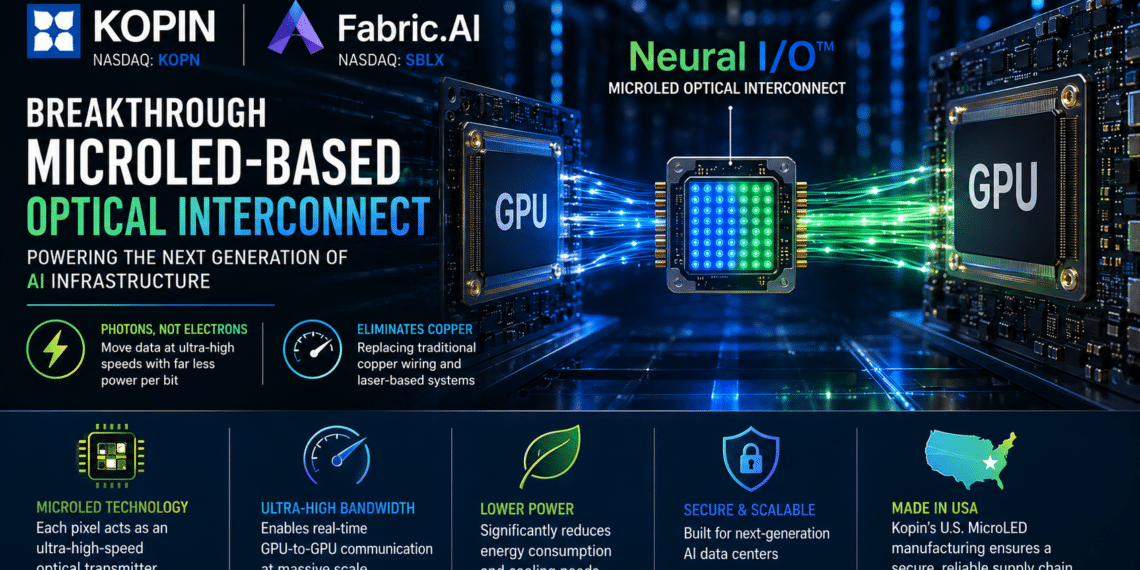
Kopin Corporation (NASDAQ: KOPN) has announced a strategic collaboration with Fabric.AI (NASDAQ: SBLX) to develop MicroLED-based optical interconnect technology aimed at transforming data center infrastructure for artificial intelligence workloads. The initiative targets one of the most pressing constraints in modern AI systems: high power consumption and bandwidth limitations associated with traditional copper-based interconnects.
As part of the agreement, Fabric.AI has placed a $15 million purchase order with Kopin to fund the development of a demonstration chipset. The companies are jointly developing what they call Neural I/O, an optical interconnect architecture designed to enable ultra-high-speed data transfer between GPUs and high-performance processors while significantly reducing energy consumption.
The technology leverages Kopin’s proprietary MicroLED platform and its patented NeuralDisplay architecture. In this design, programmable MicroLED pixels are repurposed as optical transceivers, capable of transmitting and receiving data using light instead of electrical signals. This approach is expected to deliver faster data exchange rates while consuming less power per bit compared to conventional copper wiring and laser-based optical systems.
Current AI data centers rely heavily on dense copper interconnects to facilitate communication between processors. As AI models grow in size and complexity, these systems require increasing bandwidth, which in turn drives higher energy usage and cooling demands. Industry analysts have identified interconnect efficiency as a critical bottleneck in scaling AI infrastructure.
By replacing electrons with photons for data transmission, the Neural I/O architecture aims to address these challenges. Each MicroLED pixel functions as a high-speed transmitter, enabling real-time GPU-to-GPU communication at scale. The elimination of copper wiring and complex laser components could also simplify system design and reduce operational costs.
The collaboration combines complementary capabilities from both companies. Kopin contributes expertise in MicroLED materials, process engineering, and manufacturing, while Fabric.AI focuses on system-level design and commercialization for AI infrastructure. Under the terms of the partnership, Kopin will serve as the exclusive manufacturer of the Neural I/O™ chipsets and holds a 19.9% ownership stake in Fabric.AI.
Kopin’s position as a U.S.-based producer of MicroLED displays is also seen as strategically significant. With increasing emphasis on domestic supply chains for advanced technologies, the company’s manufacturing capabilities offer potential advantages in scalability and reliability. MicroLED technology has traditionally been associated with applications in augmented and virtual reality, as well as defense and industrial display systems. Its extension into AI infrastructure represents a notable shift in application scope.
Executives from both companies emphasized the broader implications of the collaboration. They noted that AI workloads are evolving rapidly, requiring new approaches to system architecture that can support higher throughput without proportionally increasing power consumption.
Industry observers point out that data centers are becoming a major contributor to global energy demand, particularly as AI adoption accelerates. Technologies that can improve efficiency at the interconnect level are therefore gaining increasing attention.
The Neural I/O product line is expected to play a role in addressing these challenges by enabling more efficient data movement within AI systems. While still in the development phase, the initiative reflects a growing focus on hardware innovation as a key enabler of next-generation AI performance.
The collaboration also positions both companies within a rapidly expanding market for AI infrastructure components. As demand for high-performance computing continues to rise, solutions that can deliver improvements in speed, efficiency, and scalability are likely to become central to future data center design.