

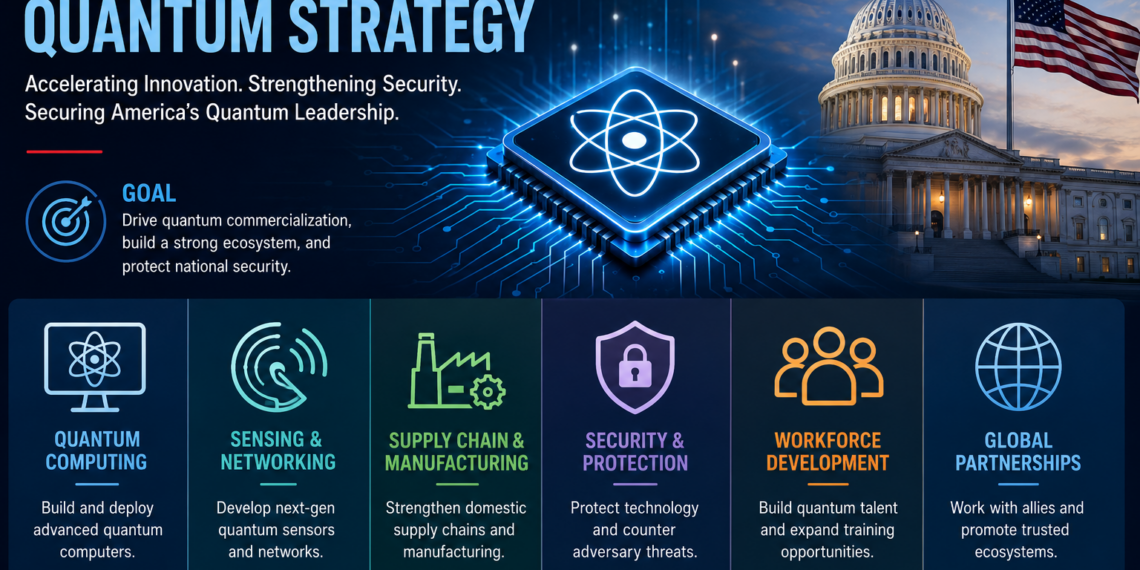
The White House has ordered a sweeping expansion of U.S. quantum technology efforts, directing federal agencies to accelerate commercialization, strengthen domestic supply chains, build a larger quantum workforce, and tighten protections around critical technologies as global competition in the sector intensifies.
The executive order, titled “Ushering in the Next Frontier of Quantum Innovation,” positions quantum information science and technology (QIST) as a strategic priority for economic growth, industrial competitiveness, and national security. The move builds on the National Quantum Initiative Act of 2018 and signals a shift in federal policy from primarily funding research toward scaling deployment and commercial adoption.
The administration said the United States must take a more coordinated approach as rival nations increase investments in quantum computing, sensing, networking, and manufacturing capabilities.
A cornerstone of the order is the creation of the Quantum Computer for Application Development and Discovery Science (QC-ADDS) initiative, a national effort to develop a quantum computer capable of enabling scientific discoveries beyond the reach of today’s classical systems. The administration intends to deploy at least one such machine at a Department of Energy facility and make it available to researchers where possible.
Within 90 days, the Department of Energy must identify the technical requirements needed for a quantum system capable of delivering transformative scientific applications with potential economic significance. The agency has also been tasked with exploring partnership models with private-sector companies, while the Department of Commerce will develop plans to encourage commercial participation, including the potential use of advance market commitments.
The Department of Defense, meanwhile, has been directed to establish or designate programs focused on preparing for national security applications of quantum computing, including the possible creation of a dedicated center.
The order extends beyond computing. Defense officials must identify at least three next-generation quantum sensor projects within 60 days, with a goal of fielding those technologies by September 2028. The Departments of Commerce and Energy, the National Science Foundation (NSF), and NASA have been instructed to develop five-year roadmaps for advancing quantum sensing, networking, manufacturing technologies, distributed quantum computing, and space-based applications.
Federal agencies are also being directed to address one of the industry’s most significant challenges: the development of a resilient domestic quantum supply chain.
The Commerce Department will lead an assessment of quantum-related supply chains and manufacturing barriers, while the Departments of Defense, Commerce, and Energy, together with NSF, will formulate plans to encourage development of quantum-enabling components in the United States. Potential measures include public-private partnerships, prize competitions, advance market commitments, and recommendations for regulatory changes aimed at overcoming market barriers.
The administration is also seeking to expand access to domestic fabrication capabilities. Within 180 days, the Defense Department must take steps to increase access to department-sponsored foundry resources and strengthen efforts to secure critical quantum supply chains. NSF will simultaneously move to establish additional user facilities through its National Quantum and Nanotechnology Infrastructure program.
National security considerations feature prominently throughout the order.
The Director of National Intelligence and the Defense Department have been instructed to assess the implications of increasingly powerful commercial quantum computers, including risks to existing encryption systems and the transition to post-quantum cryptography. The administration is also expanding efforts to protect sensitive technologies from cyber threats and foreign intelligence activities.
The Federal Bureau of Investigation will develop plans to expand the Quantum Information Science and Technology Counterintelligence Protection Team, a multi-agency effort focused on safeguarding the quantum ecosystem. The initiative is expected to strengthen threat-sharing with industry, universities, and research organizations while coordinating government outreach on quantum-related security risks.
Workforce development is another major pillar of the strategy. The Office of Personnel Management has been directed to develop a government-wide recruitment and retention plan for quantum talent, including potential special pay rates and hiring incentives. The Department of Labor will integrate quantum-related skills into workforce training initiatives and apprenticeship programs, while NSF will establish a network of National QIST Workforce Development Institutes to coordinate training efforts across the country.
Internationally, the administration is seeking closer alignment with allies on research collaboration, trusted supply chains, export controls, and technology protection. The State and Commerce Departments have been instructed to ensure U.S. quantum companies retain access to strategic markets and capital while limiting the ability of countries of concern to acquire critical quantum-enabling technologies.
The order sets a series of deadlines ranging from 60 days to one year for agencies to deliver plans, assessments, and recommendations. Together, the measures represent one of the most comprehensive federal efforts yet to move quantum technologies from the laboratory into commercial deployment.