

AiRANACULUS has secured a $5 million contract from NASA under the Civilian Commercialization Readiness Pilot Program (CCRPP) to advance intelligent networking technologies for future lunar and deep-space communications.
The 24-month program will focus on developing communications systems capable of supporting increasingly complex space missions, including lunar surface operations, orbital infrastructure and future Mars exploration. The work will be carried out in collaboration with NASA Ames Research Center and industry partners including NVIDIA, Nokia Federal Solutions, Dell Technologies, Curtiss-Wright, Supermicro and Radisys.
The Massachusetts-based company develops intelligent radio frequency (RF) and autonomous networking technologies. Under the contract, it will further develop two of its networking platforms—Cross Layer Spectrum Aware Cognitive Control Plane and Intelligent Routing Engine (CLAIRE) and Intelligent Network Slicing and Policy-based Routing Engine (INSPiRE).
The technologies are designed to improve network resilience, traffic management and communications reliability across heterogeneous wireless environments.
NASA’s Artemis program is expected to require communications networks that can support a wide range of assets operating simultaneously. These include astronaut habitats, robotic systems, lunar rovers, autonomous vehicles, scientific instruments, mining operations, orbiters and future deep-space missions.
Unlike conventional terrestrial networks, future lunar infrastructure will need to integrate multiple communications technologies, including 4G and 5G cellular, Wi-Fi and satellite communications, while operating across varying frequencies and challenging radio environments.
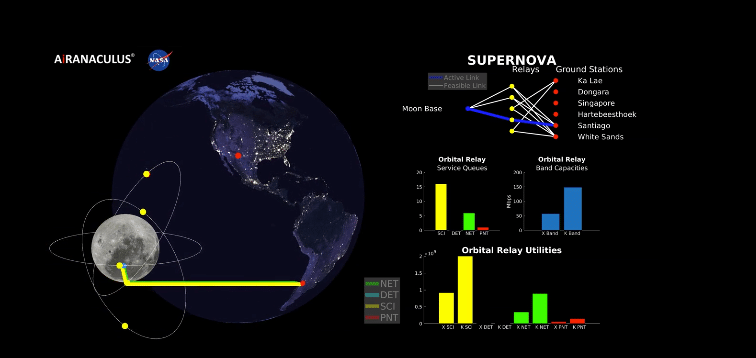
AiRANACULUS said its CLAIRE platform continuously monitors network conditions and dynamically adjusts communications based on spectrum availability, interference levels and congestion. The system is designed to maintain quality of service by automatically selecting the most efficient routing path for mission-critical data.
Its INSPiRE platform complements those capabilities through intelligent network slicing and policy-based routing across both terrestrial and space-based infrastructure. The platform leverages NVIDIA accelerated computing technologies, including the NVIDIA Aerial Testbed and GH200 Grace Hopper Superchip, to optimize network performance in real time.
The project will also include integrated testing and spaceflight validation activities with NASA Ames to increase both the Technology Readiness Level (TRL) and Manufacturing Readiness Level (MRL) of the two platforms.
As governments and commercial operators accelerate investments in the cislunar economy, communications infrastructure is emerging as a critical enabling technology. Future lunar missions will depend on networks capable of supporting autonomous operations while maintaining reliable connectivity across surface, orbital and deep-space assets.
Industry partners said intelligent networking will be essential as communications architectures become more distributed and data-intensive. Nokia Federal Solutions noted that technologies capable of integrating terrestrial cellular, Wi-Fi, satellite and cislunar communications will play an increasingly important role in future space networks.