

Robbyant, an embodied AI unit of Ant Group, has released an upgraded open-source version of its LingBot-VLA model, aiming to accelerate the development of software that enables robots to perform a wider range of real-world tasks.
The new LingBot-VLA 2.0 vision-language-action (VLA) model builds on the version introduced earlier this year and is designed to improve robots’ ability to learn and operate across different hardware platforms with minimal retraining.
The announcement comes as competition in embodied AI intensifies, with technology companies investing in foundation models that combine visual perception, language understanding and motor control to enable robots to perform complex physical tasks.
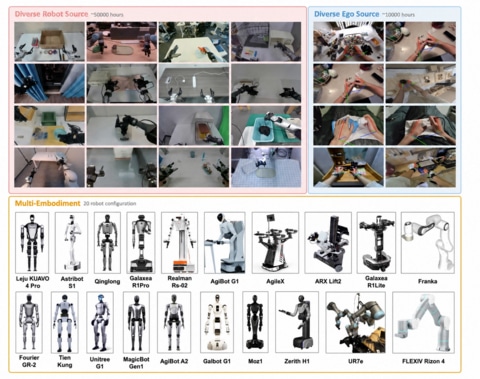
Robbyant said LingBot-VLA 2.0 was pre-trained using 60,000 hours of real-world physical interaction data, including 50,000 hours collected from robots and another 10,000 hours derived from first-person human manipulation data.
The training dataset spans 20 robot morphologies from 17 manufacturers, including Leju, AgiBot, Unitree, AgileX, Galaxea, Franka, Flexiv and Fourier. It covers a range of robotic systems, including single-arm, dual-arm, wheeled and humanoid configurations.
According to the company, the latest model expands support for additional degrees of freedom by incorporating coordinated control of the head, waist, hands and mobile chassis, enabling more complex whole-body movements.
Robbyant said benchmark testing showed the model outperformed competing vision-language-action models, including π0.5 and GR00T N1.7, in dual-arm manipulation tasks conducted on platforms developed by AgileX and Galaxea. It also reported higher task completion scores in long-horizon mobile manipulation tests on robotic systems from ARX and Astribot.
The company said it has also introduced a version of the model designed to reduce deployment costs. The optimised release delivers inference latency below 130 milliseconds on an NVIDIA RTX 4090 graphics processing unit, which Robbyant said lowers the computing requirements for commercial deployments.
The software is being evaluated in commercial pilot projects across retail, logistics and industrial automation. Robbyant said it is working with robotics companies including Leju and Ti5 Robot, while enterprise trials involve customers such as GuoDa Drugstore and Longsheng Technology.
The company is also collaborating with GenRobot.ai to develop standardised robotics datasets intended to support future embodied AI research.