

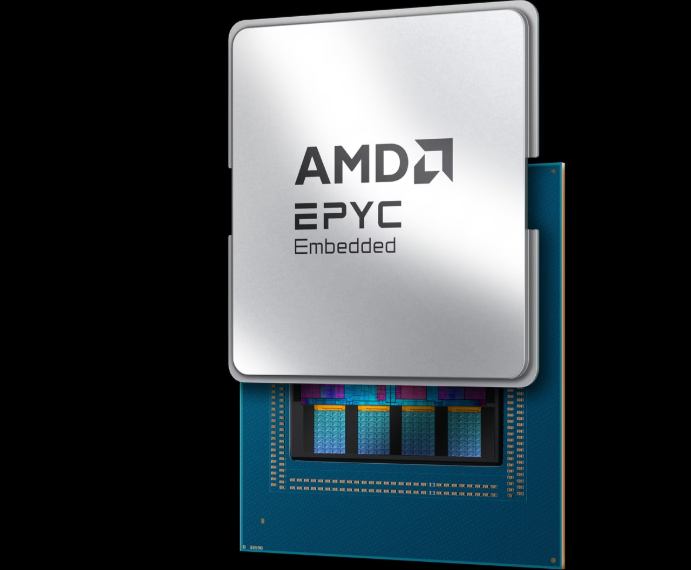
Advanced Micro Devices (NASDAQ: AMD) has launched its sixth-generation EPYC Embedded 9006 Series processors, targeting growing computing and connectivity demands across semiconductor manufacturing, enterprise storage and network security infrastructure.
Built on AMD’s Zen 6 core architecture and designed for the SP7 socket platform, the new processors offer up to 256 cores and 512 threads, alongside PCIe Gen 6 and Compute Express Link (CXL) 3.1 connectivity. AMD claims the processors deliver up to 1.8 times the throughput of its previous-generation EPYC Embedded 9005 Series, positioning them for embedded systems handling increasingly data-intensive workloads.
The launch comes as expanding artificial intelligence infrastructure places greater demands on the systems responsible for testing semiconductors, processing network traffic and managing enterprise data. Semiconductor automated test equipment (ATE), high-performance firewalls and storage controllers are among the applications requiring greater processing capacity, memory bandwidth and faster input/output (I/O) performance.
AMD said the EPYC Embedded 9006 Series is designed to address these requirements while providing long-term product availability and security support for embedded applications, which often operate in mission-critical environments and have extended deployment cycles.
Targeting Three Critical Infrastructure Markets
One of the primary applications for the new processors is semiconductor automated test equipment. As memory and I/O technologies advance, manufacturers need to validate increasingly complex devices at higher speeds and across larger volumes.
The EPYC Embedded 9006 processors serve as the control and orchestration engine in these systems, managing memory and storage testing workloads and interfaces for DDR5 Registered DIMMs (RDIMMs), emerging Multiplexed Rank DIMMs (MRDIMMs), PCIe Gen 6 devices and CXL-compatible components. Their higher core counts are also intended to enable manufacturers to execute more tests simultaneously.
Network security is another target market. The expansion of AI infrastructure is increasing network traffic, creating additional processing requirements for firewalls supporting 400G and 800G networks.
AMD said the new processors can manage security policies, network sessions and traffic flows while providing processing capacity for security workloads and connectivity to data-plane accelerators. The company claims up to 1.3 times higher firewall throughput compared with the previous generation.
In enterprise storage, the processors are designed to support NVMe connectivity, data movement and storage processing. They can accelerate functions such as compression, caching and redundant array of independent disks (RAID) operations. AMD reported up to 1.5 times higher performance on its Intelligent Storage Acceleration Library (ISA-L) benchmark compared with the preceding generation.
Higher Memory Bandwidth and Faster Connectivity
Beyond processing capacity, AMD has focused on reducing memory and I/O bottlenecks that can limit performance in data-intensive embedded systems.
The EPYC Embedded 9006 Series supports 16 DDR5 memory channels, with RDIMM speeds of up to 8,000 megatransfers per second (MT/s) and MRDIMM speeds reaching 12,800 MT/s. The processors also provide up to 96 PCIe Gen 6 lanes operating at 64 gigatransfers per second.
According to AMD, the new generation delivers up to 2.7 times higher memory bandwidth and 1.5 times higher I/O bandwidth than its predecessor. The combination of PCIe Gen 6 and CXL 3.1 is intended to support faster connections with networking equipment, storage devices, accelerators and memory expansion platforms.
The processors also incorporate security mechanisms covering firmware authentication, device identity and runtime protection. AMD’s Architecture Root of Trust (ART) establishes a hardware-based foundation for secure boot, while the AMD Security Processor provides key management and trusted execution capabilities.
The platform also incorporates Caliptra, an open-source, vendor-agnostic silicon root of trust designed to support device identity verification and remote attestation. AMD said ART supports post-quantum cryptography for firmware signing, an additional measure intended to strengthen platform security against emerging quantum computing threats.
Seven-Year Support for Embedded Deployments
Long-term availability remains an important consideration for embedded computing customers, particularly manufacturers developing equipment that must remain operational for several years.
AMD is offering seven-year product longevity for the EPYC Embedded 9006 Series, alongside ongoing firmware updates and embedded-focused software support. The processors also inherit reliability, availability and serviceability features from the EPYC 9006 server CPU architecture.
The company has secured early ecosystem support from Samsung Electronics (KRX: 005930), Lanner and Portwell, among others.
Samsung said it plans to integrate the processors with its DDR5 RDIMM and MRDIMM memory technologies, PCIe Gen 6-enabled PM1763 SSD and CXL 3.2 CMM-D MD310 memory module for manufacturing test infrastructure.
Lanner is incorporating the processors into its NCA-6145 network appliance, targeting higher-performance networking and security applications. Portwell plans to use the platform in next-generation test-and-measurement systems requiring high memory capacity and bandwidth for real-time data acquisition.
IEI Integration also highlighted the processors’ PCIe Gen 6 capabilities for storage testing, particularly their potential to enable multiple next-generation SSDs to be tested simultaneously.
Availability and Market Implications
AMD is offering the EPYC Embedded 9006 Series across configurations ranging from 64 to 256 cores, allowing customers to select processors based on workload, power, operating frequency and cache requirements.
The 128-core variant is scheduled to become available on November 15, 2026, with the remaining configurations expected to begin shipping by the end of the year.