

Vietnam has unveiled a domestically developed security semiconductor that integrates a Vietnamese cryptographic algorithm directly into silicon, marking a step toward reducing the country’s reliance on imported hardware for protecting sensitive government and critical infrastructure data.
The Government Cipher Committee and Viettel Group jointly introduced VGC v1.0, alongside what they described as Vietnam’s first domestically designed secure semiconductor platform. The initiative aims to strengthen national control over the design, verification and deployment of hardware used in sensitive information systems.
The development comes as governments increasingly view semiconductor security as a strategic concern, particularly as digital infrastructure expands and data protection requirements become more complex. Dependence on foreign-designed chips can introduce supply chain and security risks, especially in systems handling government communications, financial information and critical infrastructure operations.
VGC v1.0 integrates the country’s domestically developed cryptographic algorithm into the chip’s hardware architecture rather than relying entirely on software-based encryption. According to the developers, this approach improves processing efficiency while giving Vietnam greater control over the security mechanisms embedded in its digital systems.
28nm Chip Delivers 15 Times Faster Encryption
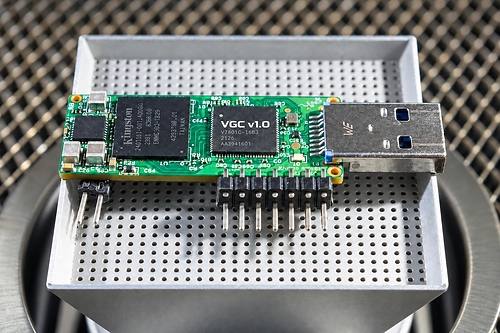
The VGC v1.0 chip contains approximately 300 million transistors, measures 10 × 10 millimeters and is manufactured using a 28-nanometer complementary metal-oxide-semiconductor (CMOS) process.
Performance testing showed that the chip executed encryption and decryption operations approximately 15 times faster than a software-only implementation performing the same tasks.
The first production batch passed technical testing and received certification for socioeconomic applications in the first quarter of 2026. The development team also implemented safeguards during the design and fabrication stages to reduce the risks of intellectual property leakage and reverse engineering.
The project combines the Government Cipher Committee’s cryptographic expertise with Viettel’s semiconductor engineering capabilities. The committee’s M2 unit established security requirements, developed the cryptographic algorithm and defined evaluation criteria. Viettel’s Semiconductor Center handled the chip’s design and implementation.
The underlying platform uses the open RISC-V instruction set architecture, allowing Vietnamese engineers to modify processor designs and reuse established verification processes when developing subsequent generations of security chips.
Government, Financial and Infrastructure Applications
VGC v1.0 has already entered initial deployment in secure USB storage devices intended for government, Party and defense agencies.
Potential applications include Vietnam’s national digital signature certification system, which has more than two million digital certificates in circulation. The chip could also support data protection in financial services, connected cameras, sensors and critical infrastructure systems spanning electricity, water, oil and gas, and telecommunications.
However, products intended to protect state secrets will require additional testing and certification under applicable standards before deployment.
Viettel Chairman and CEO Lieutenant General Tao Duc Thang said developing secure semiconductor chips requires accumulated technical expertise, investment and specialized talent.
He added that Vietnam intends to build domestic capabilities in strategically important technologies rather than remain dependent on external suppliers.
Viettel Expands Domestic Semiconductor Ambitions
Alongside the chip launch, the Government Cipher Committee and Viettel signed an agreement covering volume production, multicore security processors, specialized workforce development and testing across real-world devices.
Viettel is also developing a semiconductor fabrication plant in Hoa Lac as part of its broader efforts to establish domestic capabilities across chip design, manufacturing and packaging.