

Kioxia Holdings Corporation (TSE: 285A) and NVIDIA (NASDAQ: NVDA) are collaborating on a storage architecture designed to expand the effective memory capacity available to graphics processing units (GPUs), potentially enabling AI systems to work with datasets at petabyte scale.
The companies demonstrated the approach using NVIDIA’s Scaled Accelerated Data Access (SCADA) software and Storage-Next technologies with Kioxia’s high-performance solid-state drives (SSDs). The proof of concept processed a database containing 2 trillion vectors on an NVIDIA GB200 NVL72 rack-scale system equipped with 144 Kioxia XD8 Series 7.68-terabyte E1.S NVMe SSDs.
The demonstration addresses a growing challenge in AI infrastructure: the increasing size of datasets is placing pressure on high-bandwidth memory (HBM), the high-speed memory used by GPUs. When datasets exceed available HBM capacity, systems may need to divide workloads into smaller segments and repeatedly transfer data between memory and slower storage. These operations can add complexity and affect processing efficiency.
SSDs Extend Access to Large AI Datasets
The collaboration explores how NVMe SSDs can serve as an additional tier of high-capacity storage, allowing GPUs to access larger datasets without relying exclusively on HBM. NVIDIA SCADA is designed to extend effective GPU memory capacity through SSDs, including support for fine-grained data access using small block sizes.
Combined with Storage-Next software technologies, the approach aims to make large datasets more accessible for AI workloads. It could be particularly relevant to applications that depend on extensive vector databases and graph neural networks (GNNs), where systems must retrieve and process large volumes of interconnected data.
The proof-of-concept configuration included 18 server nodes, with eight SSDs supporting each node. The 144 drives provided approximately 1.1 petabytes of raw flash storage capacity, equivalent to nearly 60 terabytes of flash-based extended memory per node.
The architecture also supported 512-byte data accesses and demonstrated the potential to handle 2 trillion 512-byte vectors across the system. The configuration illustrates how flash storage could complement GPU memory in workloads involving large-scale data retrieval.
Addressing AI Infrastructure Constraints
NVIDIA said the ability of AI agents to access larger knowledge bases will become increasingly important as their capabilities develop. Jason Hardy, vice president of storage technology at NVIDIA, said technologies such as SCADA and Storage-Next could improve memory efficiency and expand the data available to AI applications.
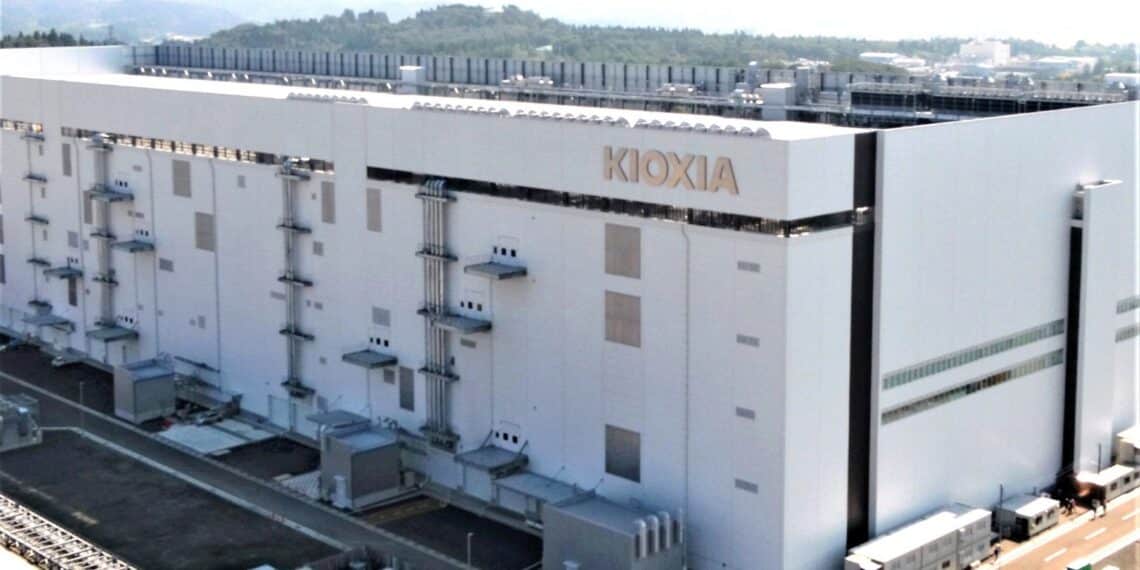
For Kioxia, the collaboration provides an opportunity to demonstrate how flash storage can contribute to the evolving requirements of AI and high-performance computing. Neville Ichhaporia, senior vice president and general manager of Kioxia America’s SSD business unit, said handling massive datasets is becoming increasingly important as AI applications advance.
Kioxia is continuing to develop its XD8 Series and GP Series Super High IOPS SSDs for demanding workloads. The company and NVIDIA are also evaluating the technical feasibility and performance of SCADA and the Storage-Next architecture.
The demonstration remains a proof of concept rather than a commercial deployment announcement. Its significance lies in exploring how storage technologies could help address memory-capacity constraints as AI models, agent-based systems, and data-intensive applications continue to scale.