

Keysight Technologies Inc. has expanded its 1.6T Ethernet interconnect validation portfolio, extending support to passive copper and low power optical technologies to address the evolving requirements of artificial intelligence (AI) and high-performance computing (HPC) infrastructure.
The enhanced portfolio is designed to validate a wide range of 1.6T-capable interconnects, including Direct Attach Cables (DAC), Active Copper Cables (ACC), Low Power Optics (LPO), and Linear Receive Optics (LRO). These technologies are increasingly critical as data centers scale to support high-speed, low-latency workloads driven by AI and compute-intensive applications.
As next-generation AI and HPC environments demand ultra-high Ethernet speeds, interconnect technologies must balance performance with cost efficiency and reduced power consumption. This challenge is amplified by projections indicating that global data center power demand could rise significantly by the end of the decade, making energy-efficient networking solutions a priority for operators.
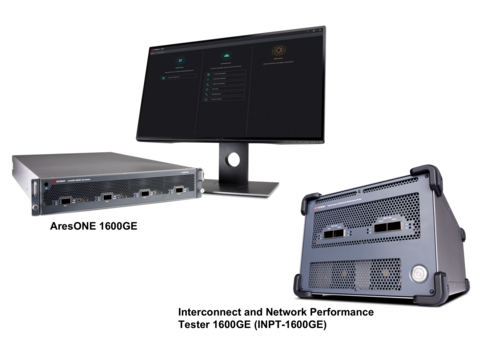
To address these requirements, Keysight has enhanced its Interconnect and Network Performance Tester 1600GE (INPT-1600GE) and complemented it with the AresONE 1600GE test systems. These platforms are designed to accurately measure and characterize error performance across a broader range of 224G interconnects, enabling manufacturers and network operators to identify reliable solutions and mitigate risks associated with network downtime.
The expanded validation capabilities cover multiple interconnect categories. These include coherent optical transceivers for long-distance data center interconnects, fully retimed optical transceivers for mid-range applications, and low power optics for high-density switching environments. Linear receive optics extend reach while conserving power, while active electrical and copper cables support intra-rack and short-reach deployments. Passive copper DACs continue to provide low-power, cost-effective connectivity within rack environments.
Advances in silicon technologies, such as digital signal processors (DSPs), retimers, and linear amplifiers, are driving innovation across these interconnect types. These components enable higher data rates and extended reach at 224G lane speeds, while also reducing latency and cost. However, they introduce complexity in tuning and optimization, requiring multiple validation cycles to achieve optimal performance.
As a result, system-level validation has become increasingly important. Fully assembled interconnects must be tested in real-world environments, often connected to GPUs, network interface cards, switches, and routers. Keysight’s solutions are designed to support long-duration testing under such conditions, allowing network designers to evaluate performance beyond basic interoperability and make informed deployment decisions.
Scott Schube noted that as AI and HPC networks scale to 1.6T, there is growing demand for interconnect solutions that extend reach while minimizing power consumption and cost. He highlighted the role of active copper cables and the importance of validation infrastructure in ensuring reliable performance in production environments.
Semtech is among the ecosystem players contributing to this transition, with solutions designed to support emerging interconnect requirements.
According to Ram Periakaruppan, the company’s second-generation 1.6T test capabilities are aimed at addressing the challenges associated with 224G interconnects. He added that Keysight continues to support industry standards development through its involvement in organizations such as IEEE 802.3, OIF, and other multi-source agreements.