


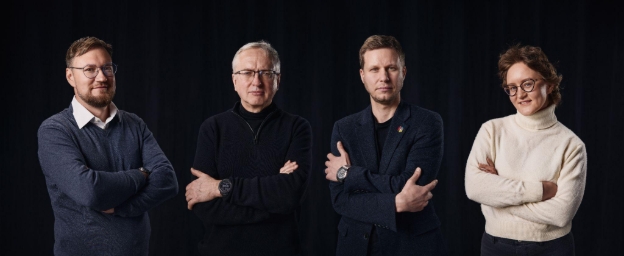
Latvian startup Deep Space Energy has closed a €930,000 pre-seed funding round aimed at accelerating development of a radioisotope-based power generator designed for lunar missions and strategic satellite infrastructure.
The round includes €350,000 in private investment led by Outlast Fund and angel investor Linas Sargautis, former co-founder of NanoAvionics. An additional €580,000 has been secured through public contracts and grants from the European Space Agency (ESA), NATO’s Defence Innovation Accelerator for the North Atlantic (DIANA), and the Latvian government.
The company said the capital will be directed toward further development and commercialisation of its radioisotopic generator technology, with the broader objective of strengthening Europe’s sovereign space and defence capabilities while supporting future Moon surface exploration.
Deep Space Energy’s system is based on radioisotopes derived from nuclear waste, which produce heat through natural decay. According to founder and CEO Mihails Ščepanskis, the company’s technology converts that heat into electricity using a more efficient process than traditional radioisotope thermoelectric generators (RTGs) currently deployed in space missions.
“Our technology, which has already been validated in the laboratory, requires five times less radioisotope fuel than conventional RTG systems,” Ščepanskis said. “This opens up new possibilities both for satellite resilience and lunar surface operations.”
In the near term, the company is focusing on auxiliary energy systems for high-value, dual-use satellites. Unlike solar-dependent systems, the radioisotope generator would provide backup power independent of sunlight, enhancing redundancy and resilience against malfunctions or non-kinetic disruptions.
The company emphasized that its technology is not designed for weapons applications. Instead, it targets satellites operating in Medium Earth Orbit (MEO), Geostationary Orbit (GEO), and Highly Elliptical Orbit (HEO)—orbits critical for reconnaissance, early warning systems, synthetic aperture radar (SAR), signal intelligence, and missile-launch detection.
Ščepanskis pointed to recent geopolitical developments as evidence of satellite infrastructure’s strategic importance. He noted that Europe remains heavily reliant on US defence space assets, particularly for high-value GEO capabilities, underscoring the need for greater regional autonomy.
“As Europe moves toward greater independence, it is imperative to produce satellites with advanced capabilities domestically,” he said. “Our technology provides an auxiliary energy source that strengthens operational reliability.”
Beyond defence infrastructure, Deep Space Energy is positioning its generator as a key enabler of the emerging lunar economy. The technology is being developed to support programmes such as NASA and ESA’s Artemis and Argonaut missions, lunar rover deployments, and broader Moon Village initiatives.
Lunar conditions present unique energy challenges. Nighttime temperatures can fall below minus 150 degrees Celsius, and lunar nights last approximately 354 hours, limiting the effectiveness of solar panels. The company’s generator is designed to ensure rover survival and sustained operations during prolonged darkness and in permanently shadowed regions.
According to the company, approximately 2 kilograms of Americium-241 fuel would be sufficient to generate 50 watts of power for a lunar rover, compared with roughly 10 kilograms required by legacy RTG systems for similar output. With projections suggesting Americium-241 production capacity could reach around 10 kilograms annually by the mid-2030s, improved efficiency could significantly expand mission capacity and timelines.
Ščepanskis said extending rover lifetimes across multiple lunar day-night cycles—potentially up to several years—would dramatically improve mission economics. Launch costs to the Moon can reach up to €1 million per kilogram, making durability and energy efficiency critical factors.
Egita Poļanska, partner at Outlast Fund, said the investment aligns with Europe’s expanding space ambitions.
“Space energy technology has faced limitations for decades, but advancements in materials, smarter systems, and growing commercial demand are creating conditions for breakthrough,” Poļanska said. “Deep Space Energy is building foundational infrastructure that could power the next phase of lunar exploration and industry.”
Linas Sargautis, who has joined the company as an advisor, highlighted the Baltic region’s growing presence in space technology.
“The Baltic region is increasingly recognised for innovation in space systems,” he said. “Supporting Deep Space Energy helps lay the groundwork for future lunar and deep-space missions while contributing to European defence capabilities.”