

AI robotics startup Skild AI has raised nearly $1.4 billion in new funding, lifting its valuation above $14 billion and placing it among the most highly valued private robotics companies globally.
Founded in 2023 and headquartered in Pittsburgh, Skild AI is developing what it describes as a unified foundation model for robotics—software designed to operate across a wide range of machines, tasks, and environments. The latest round was led by SoftBank Group, with participation from NVentures, NVIDIA’s venture capital arm, Macquarie Capital, Jeff Bezos through Bezos Expeditions, Disruptive, and 1789 Capital. Existing investors including Lightspeed, Felicis, Coatue, and Sequoia Capital increased their stakes, while strategic backers such as Samsung, LG, Schneider Electric, CommonSpirit, and Salesforce Ventures joined the round.
The financing brings Skild AI’s total funding to more than $1.7 billion since inception, reflecting intensifying investor interest in “physical AI”—systems that extend artificial intelligence beyond software into real-world machines and environments.
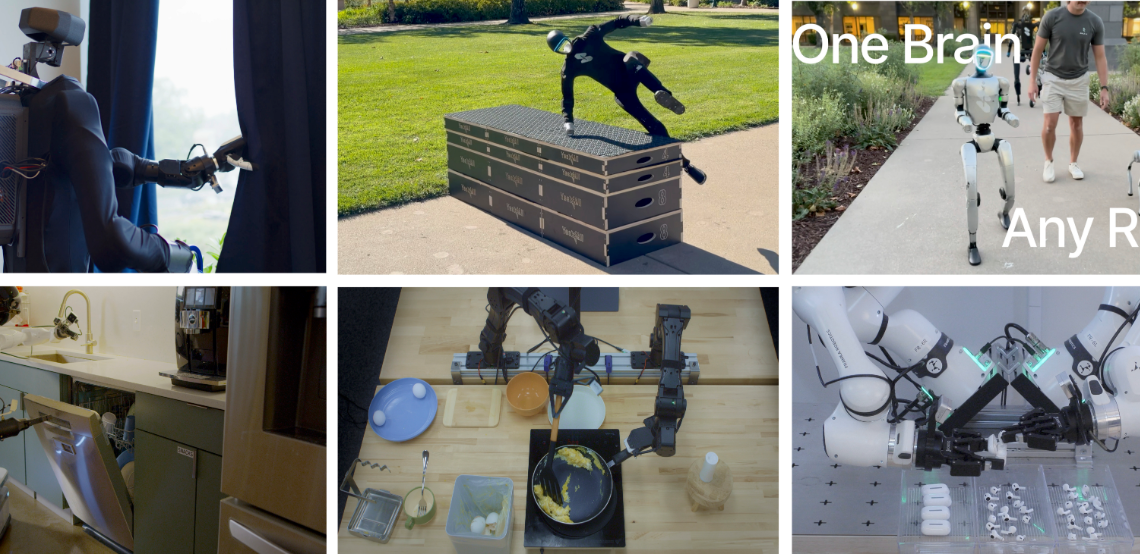
At the core of Skild AI’s technology is the Skild Brain, an omni-bodied robotics foundation model that can control different types of robots without being customized for specific hardware. According to the company, the model is capable of operating quadrupeds, humanoids, mobile manipulators, and industrial arms, adapting dynamically to new physical forms and conditions without retraining.
Unlike traditional robotics systems that are tightly coupled to specific machines or use cases, Skild AI’s approach aims for generality. The company addresses one of robotics’ longstanding challenges—the lack of large-scale, real-world training data—by pre-training its model using human activity videos and physics-based simulations. This allows the system to learn behaviors across varied scenarios and morphologies before deployment.
Skild AI says the Skild Brain can also adapt to unexpected failures or changes, such as damaged components, altered payloads, or entirely new robot bodies. This adaptability is enabled through in-context learning, where the system modifies behavior in real time based on live feedback rather than relying on preprogrammed instructions. The company’s research has received Best Paper nominations at leading robotics conferences, signaling growing academic recognition of the approach.
Co-founder and CEO Deepak Pathak said the goal is to build a single, continuously improving intelligence layer for machines. “The model is forced to adapt rather than memorize,” Pathak said, likening the system’s behavior to learning in nature. President and co-founder Abhinav Gupta added that such adaptability is critical for deploying robots safely and reliably in unstructured human environments.
Beyond research, Skild AI has begun commercial deployments. In 2025, the company reported rapid revenue growth, reaching approximately $30 million within months. Its technology is being deployed in security and facility inspection, logistics and delivery, warehousing, manufacturing, data centers, and construction environments. The company positions itself as a contributor to the automation of industrial operations and the modernization of manufacturing.
While enterprise and industrial use cases are the near-term focus, Skild AI has stated that consumer applications remain a longer-term objective. The newly raised capital will be used to scale model training, expand deployments, and accelerate product development.
Investors see the company’s technology as strategically significant. SoftBank Investment Advisers described Skild AI as foundational to the development of physical AI across robots and environments, while others emphasized its potential national and economic importance.