

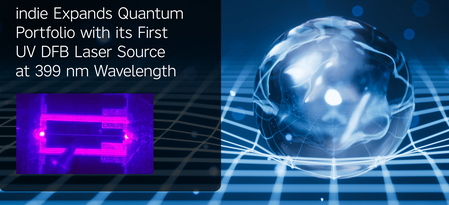
indie (Nasdaq: INDI) has expanded its quantum-focused photonics portfolio with the launch of its first ultraviolet (UV) distributed feedback (DFB) laser source, targeting advanced quantum computing applications. The newly introduced device operates at a 399 nm wavelength and is optimized for systems based on cooled ytterbium atoms, a key component in emerging quantum architectures.
The product, designated ELA350028, marks indie’s entry into the UV spectral range and builds on its existing lineup of visible DFB laser technologies. The move reflects the company’s broader strategy to diversify beyond automotive into adjacent high-growth domains such as quantum computing and advanced robotics, including humanoid systems. The expansion also underscores increasing traction for indie’s photonics division, which is gaining relevance in next-generation computing and sensing technologies.
Photonics is widely recognized as a foundational element in quantum systems, enabling critical functions such as atom cooling, trapping, pumping, and entanglement. Quantum platforms based on cold-atom and trapped-ion architectures rely on multiple laser sources precisely tuned to atomic transitions. In this context, compact and scalable semiconductor-based laser solutions are becoming increasingly important to support system efficiency and commercialization.
The ELA350028 laser is engineered specifically for the ytterbium transition at 398.9 nm, enabling efficient atom cooling. It delivers a narrow-linewidth, single-frequency output with a single spatial mode (TEM₀₀), and supports optical power levels of up to 30 mW in a compact TO-56 package. The company indicated that higher output levels—reaching several hundred milliwatts—could be achieved through a DFB-MOPA architecture with an integrated amplifier section.
According to Philipp Vorreau, Vice President and General Manager of indie’s Photonics Division, highly stable, mode-hop-free laser sources are critical for quantum computing platforms based on atom cooling and trapped ions. He noted that extending visible DFB technology into the UV spectrum enables system developers to access essential atomic transitions with a compact and scalable semiconductor solution.
The device leverages indie’s established visible DFB architecture to deliver sub-megahertz linewidth performance while maintaining a single longitudinal mode. This design eliminates the need for external cavity gratings or frequency-doubling techniques traditionally used to achieve UV wavelengths. It also ensures high side-mode suppression and low-noise operation, both of which are essential for precision quantum experiments and scalable computing platforms.
Additionally, the laser offers stable, mode-hop-free performance across a wide range of current and temperature conditions, supporting consistent operation in demanding research and industrial environments.
indie Semiconductor has begun sampling the ELA350028 with customers.