

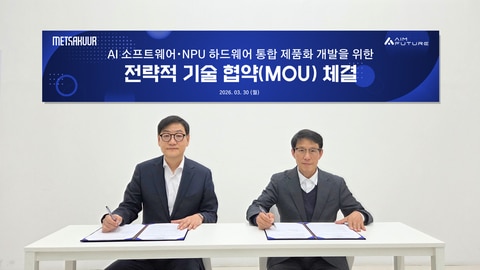
AI semiconductor IP firm AiM Future has announced a strategic partnership with Metsakuur Company to develop and commercialize NPU-integrated hardware products, signaling its expansion into full-stack solutions for the global edge AI market.
The collaboration focuses on combining AiM Future’s neural processing unit (NPU) technology with Metsakuur’s advanced vision AI algorithms to create fully integrated hardware platforms. The companies aim to deliver a comprehensive “AI total package” that merges optimized software with high-performance hardware, enabling faster deployment without the need for additional customization.
AiM Future has already demonstrated its NPU capabilities through commercial deployments in home appliances produced by LG Electronics. Designed for low-power, high-efficiency computing, the NPU is well-suited for edge applications such as AIoT devices, smart home systems, and robotics.
As part of the agreement, AiM Future will supply its market-proven NPU technology, while Metsakuur will integrate and optimize its proprietary AI algorithms onto the hardware. The companies state that this integration will enhance processing performance while significantly reducing power consumption, allowing AI workloads to be executed more efficiently at the edge.
Kim Chang-soo, CEO of AiM Future, said the partnership provides an opportunity to demonstrate the full performance capabilities of its NPU in real-world use cases. He described the collaboration as a key step in strengthening the company’s position in the evolving edge AI landscape.
Lee Ji-hoon, CEO of Metsakuur Company, noted that the partnership moves beyond software delivery to establish a complete product lineup that integrates both hardware and AI technologies. He added that the combined approach enhances product stability and reliability.
The companies plan to target high-growth sectors including smart cities, intelligent security systems, and embedded AI devices. By aligning hardware and software development, the partnership aims to improve operational efficiency and address increasing demand for scalable, energy-efficient AI solutions.