

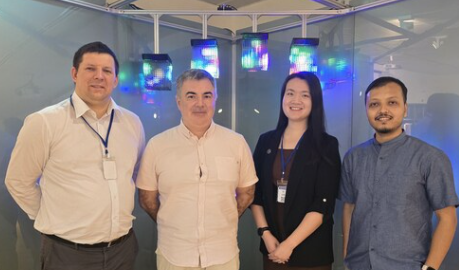
ATLANT 3D and the Institute for Functional Intelligent Materials (I-FIM) at the National University of Singapore have signed a Memorandum of Understanding (MOU) to establish a shared, AI-driven materials discovery foundry in Singapore. The initiative will be housed within the robotic laboratory at CREATE (Campus for Research Excellence and Technological Enterprise).
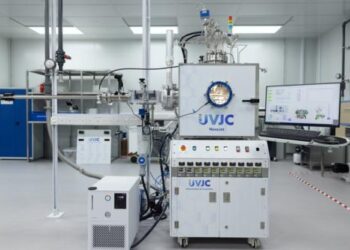
The collaboration aims to integrate atomic-scale manufacturing with artificial intelligence to accelerate the discovery and development of advanced materials. As part of the agreement, ATLANT 3D will deploy its Direct Atomic Layer Processing (DALP®) technology and NANOFABRICATOR® platform as a core synthesis system within NUS I-FIM’s robotic materials hub. These tools are designed to support automated, AI-driven workflows for material synthesis, experimentation, and data generation.
The foundry will be accessible to researchers across participating programs and is expected to support a wide range of applications. Key focus areas include two-dimensional (2D) materials, nanoelectronics, advanced semiconductor packaging, quantum materials, photonics, and catalytic materials discovery. By enabling precise fabrication at the atomic level alongside AI-powered experimentation, the platform aims to shorten research cycles and improve the efficiency of materials innovation.
The initiative aligns with Singapore’s AI for Science program, supported by the National Research Foundation (NRF). The program promotes the use of artificial intelligence and automation in scientific research, including the development of self-driving laboratories capable of continuous, data-driven experimentation.
Both organizations view the project as a long-term effort to build scalable research infrastructure. The proposed foundry is intended to serve as a model for future automated laboratories, combining robotics, advanced manufacturing, and machine learning to enable more efficient and reproducible research processes.
Dr. Maksym Plakhotnyuk, CEO and Founder of ATLANT 3D, said the partnership reflects the potential of combining atomic-scale manufacturing with AI-driven methodologies. Professor Sir Kostya S. Novoselov of NUS I-FIM highlighted the importance of integrating advanced fabrication technologies into research workflows to accelerate discovery and enable new scientific directions.