


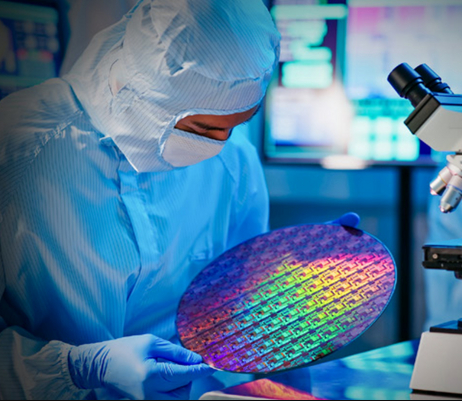
South Korean industrial AI startup AiBiz is challenging the long-held assumption that advanced artificial intelligence workloads in semiconductor manufacturing require graphics processing units (GPUs), deploying a CPU-based platform that detects wafer defects in real time while improving manufacturing yield and reducing production costs.
The six-year-old company has developed DutchBoy, an AI-powered defect detection platform that runs on AMD’s (Nasdaq: AMD) EPYC server processors instead of GPUs. Designed for semiconductor fabrication facilities, the system analyzes sensor data generated during wafer production to identify process anomalies before they result in defective chips.
The approach is aimed at addressing one of the semiconductor industry’s longstanding challenges: detecting manufacturing defects early enough to prevent yield losses. Conventional quality inspections often occur near the end of the production cycle, when identifying defects can lead to scrapping completed wafers after significant manufacturing costs have already been incurred.
“Our product is called DutchBoy,” said Seung-Jae Ha, Chief Executive Officer of AiBiz. “The name comes from the story of a young boy who prevents a disaster by plugging a hole in a dam. Our software performs a similar role for semiconductor wafers by identifying problems before they become larger failures.”
Rather than relying on final-stage inspection, DutchBoy continuously monitors sensor data generated throughout wafer fabrication. According to the company, the platform is deployed directly within Samsung Electronics’ manufacturing environment, where it is installed alongside etching equipment to analyse production conditions in real time.
“The quality check is usually done at the very end of production, so defects are detected very late,” said Hyun Jin Choi, Chief Technology Officer of AiBiz. “By using sensor data, we can identify problems as they occur, allowing engineers to intervene much earlier.”
The volume of manufacturing data processed by the platform is substantial. AiBiz said each deployment collects readings every 100 milliseconds from approximately 300 sensors installed across 20 pieces of semiconductor manufacturing equipment, creating a continuous stream of operational information.
DutchBoy processes this data using a containerised architecture built on Docker. The platform combines a time-series anomaly detection model with a graph neural network (GNN), enabling it to analyse relationships between temperature, pressure and other process variables inside semiconductor etching chambers.
Unlike large generative AI models containing billions of parameters, DutchBoy’s AI models contain fewer than 100,000 parameters. According to AiBiz, that smaller model size allows inference to run efficiently on CPUs without requiring dedicated GPU acceleration.
“Very large parameter quantities necessitate the use of GPUs,” Choi said. “But because we’re able to consolidate parameters, we can maintain a very small model. That allows us to avoid using a GPU and instead use CPUs.”
The company also cited practical advantages for semiconductor fabrication facilities, where power consumption, cooling requirements and hardware footprint remain critical operational considerations. Eliminating GPUs reduces heat generation and avoids latency associated with transferring workloads between CPUs and GPUs, Choi added.
AiBiz said its transition to AMD EPYC processors followed performance limitations encountered with its previous infrastructure.
“We were using Intel before, but we kept experiencing bottleneck problems,” Choi said. “We realised that multithreading was the solution, so we started looking for processors with stronger multithreading capabilities, which led us to AMD.”
AMD worked closely with AiBiz during the deployment process. According to the companies, Varun Selvaraj, Senior Manager of Business Development at AMD, advised AiBiz on selecting EPYC processors suited to its inference workloads by balancing processor core counts, clock speeds, cache capacity and memory bandwidth.
AMD also supplied early evaluation hardware and coordinated technical sessions between AiBiz and server manufacturers to optimise deployment configurations.
“Our goal was to match the right EPYC CPU—the right cores, frequency, cache and memory bandwidth—to AiBiz’s lightweight models so the intelligence runs efficiently where the sensor data lives,” Selvaraj said. “AiBiz has proven that AI does not require a GPU, and that it does not have to compromise on performance.”
Hardware vendor Hewlett Packard Enterprise (NYSE: HPE) also supported the project by helping AiBiz select appropriate server configurations for its deployment strategy, particularly as the company prepares for international expansion.
Following optimisation, AiBiz reported a 30% increase in AI inference performance compared with its previous Intel-based systems.
The improved performance translates directly into manufacturing outcomes. One example cited by the company involves detecting “arcing,” electrical discharge events inside semiconductor etching chambers that can damage wafers and reduce manufacturing yield.
“When arcing occurs, we observe a data spike,” Choi said. “We immediately provide real-time information to engineers so they can prevent wafer defects before they happen.”
The financial impact of preventing such failures can be significant. According to AiBiz, a single memory wafer can cost approximately 20 million won (about $13,500). Manufacturers traditionally inspect only a sample of wafers, meaning undetected defects can result in multiple wafers being discarded.
AiBiz estimates that preventing defects across a batch of 20 wafers could save approximately 380 million won (about $255,000). Applied across daily production over a year, the company estimates potential savings approaching 150 billion won (around $100 million), excluding additional benefits from improved production yield.
Beyond defect prevention, AiBiz said DutchBoy can improve semiconductor manufacturing yields by 3% to 5%, a gain that could translate into substantially higher production output at high-volume fabrication plants.
The company has already deployed AMD EPYC 9355 and 9554 server processors at Samsung manufacturing facilities in South Korea and Xi’an, China. AiBiz now plans to expand deployments to outsourced semiconductor assembly and test (OSAT) facilities and LG Innotek, while pursuing opportunities with additional semiconductor manufacturers including SK hynix, Intel Corporation (Nasdaq: INTC) and Micron Technology (Nasdaq: MU).
The expansion reflects growing interest in lightweight AI models capable of performing specialised industrial tasks without relying on increasingly expensive GPU infrastructure. As semiconductor manufacturers seek to improve production efficiency while controlling operating costs, CPU-based AI inference may offer an alternative for narrowly focused industrial applications where model size and latency are more important than large-scale generative AI capabilities.
For AiBiz, that distinction is central to its technology strategy. The company argues that AI inference does not necessarily require GPU acceleration if models are designed specifically for industrial workloads, potentially lowering deployment costs while reducing power consumption and simplifying infrastructure requirements for manufacturers operating at scale.