

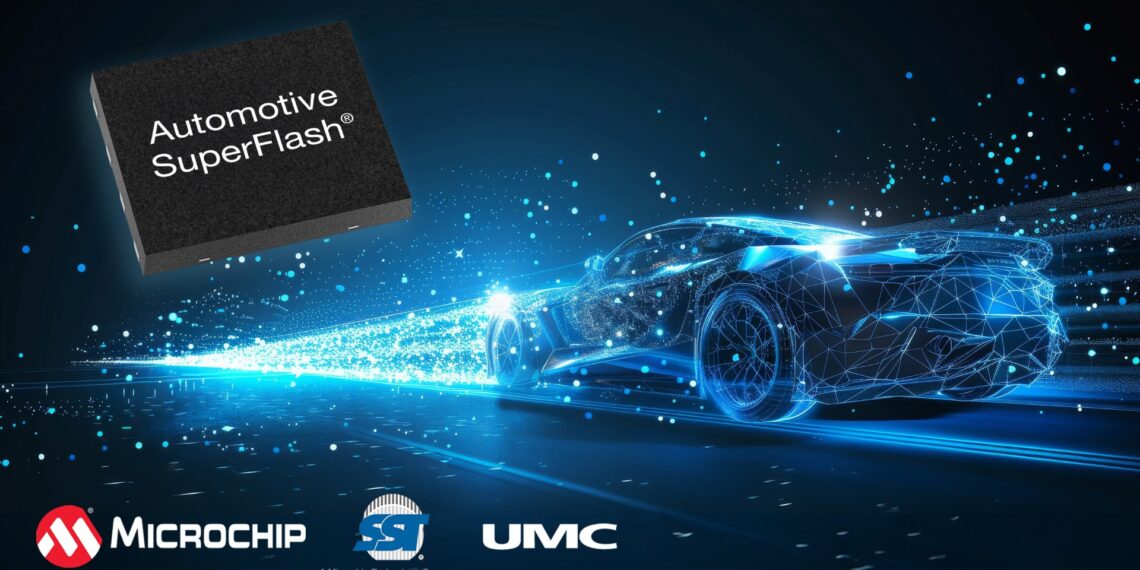
Silicon Storage Technology (SST), a subsidiary of Microchip Technology, and United Microelectronics Corporation (UMC) (NYSE: UMC: TWSE: 2303) have announced the immediate production availability of SST’s embedded SuperFlash® Gen 4 (ESF4) memory platform with full Automotive Grade 1 (AG1) qualification on UMC’s 28HPC+ process technology. The announcement marks a significant step in addressing the automotive industry’s growing demand for higher-performance, highly reliable embedded non-volatile memory solutions for advanced vehicle controllers.
As vehicles become increasingly software-driven, automotive controllers are required to handle greater processing loads, support frequent firmware updates, and operate reliably under extreme environmental conditions. SST and UMC state that the newly qualified 28nm ESF4 AG1 platform is designed to meet these requirements while offering improved manufacturing efficiency compared to other embedded flash solutions at the same technology node.
Developed through close collaboration between the two companies, ESF4 delivers enhanced embedded non-volatile memory (eNVM) performance and long-term reliability for automotive applications. A key differentiator of the platform is its reduced process complexity. SST noted that ESF4 requires significantly fewer additional masking steps than other foundries’ 28nm High-k/Metal-Gate (HKMG) embedded flash implementations, helping customers achieve cost advantages and improved manufacturing throughput.
The companies are positioning the 28nm ESF4 AG1 platform as a natural migration path for customers currently using 40nm ESF3 AG1 technologies in automotive controller designs. As automotive semiconductor developers scale to more advanced nodes, the new platform aims to provide continuity in performance and reliability while enabling higher levels of integration and functionality.
Mark Reiten, Vice President of Microchip’s licensing business unit, said the joint solution is designed to help developers meet accelerating automotive requirements. He noted that the platform supports efficiency, faster time to market, and compliance with stringent automotive standards, adding that UMC has been a long-standing partner in advancing SuperFlash technology for evolving market needs.
From the foundry perspective, UMC highlighted the growing importance of reliable embedded memory as vehicles move toward greater connectivity, autonomy, and shared mobility. Steven Hsu, Vice President of Technology Development at UMC, said demand for high-reliability data storage and large-capacity firmware updates has driven interest in scaling SuperFlash technology to the 28nm node. By integrating ESF4 into the widely adopted 28HPC+ platform, UMC enables customers to leverage its existing IP ecosystem and design models while transitioning to a more advanced manufacturing process.
The 28HPC+ ESF4 AG1 platform meets Automotive Electronics Council (AEC) Q-100 Grade 1 requirements, supporting operating junction temperatures from –40°C to +150°C. Performance metrics include read access times below 12.5 nanoseconds, endurance exceeding 100,000 program/erase cycles, and data retention greater than 10 years at 125°C. The platform requires only single-bit error correction code (ECC), and qualification testing of a 32Mb macro under automotive Grade 1 conditions demonstrated zero bit failures without ECC and peak yields reaching 100 percent.
Automotive controller shipment volumes continue to rise as vehicles incorporate more electronic control units across powertrain, safety, infotainment, and advanced driver assistance systems. Embedded non-volatile memory remains a critical component for storing code and data reliably throughout a vehicle’s operational life. SST and UMC indicated that the ESF4 solution is particularly suited for controllers requiring high-capacity firmware storage and over-the-air update capability, supporting the industry’s shift toward software-defined vehicles.