

BASF has launched a next-generation yellow-light material solution aimed at improving energy efficiency and reducing carbon emissions in semiconductor and other precision manufacturing environments.
The new technology targets industries that rely on photolithography-driven processes, including semiconductor fabrication, printed circuit board (PCB) production, display manufacturing, LED manufacturing, and solar energy applications.
BASF said the solution is designed to replace conventional yellow fluorescent lamps and filter-based LED systems commonly used in controlled manufacturing facilities where strict wavelength management is required.
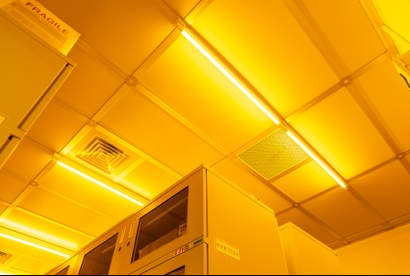
Yellow-light environments play a critical role in semiconductor and electronics manufacturing because exposure to short wavelengths can interfere with sensitive photolithography processes. Traditional lighting systems typically filter out wavelengths below 530nm to protect production environments, but the filtering process results in significant energy loss.
According to BASF, its new material technology uses an absorption-conversion mechanism that blocks harmful wavelengths while converting them into usable yellow light. The company said this approach improves energy utilization and system efficiency without compromising spectral precision required for advanced semiconductor manufacturing.
The solution is also designed to integrate into existing industrial lighting infrastructure, including tubes, panels, and explosion-proof fixtures, without requiring significant modifications to current power or thermal systems. BASF said this simplifies deployment and lowers implementation risks for manufacturers.
The company stated that the technology can reduce energy consumption by approximately 25% compared with traditional fluorescent and filter-based LED yellow-light systems. Lower heat transmission is also expected to improve operational stability and extend service life in high-performance industrial environments.
BASF added that the material solution complies with RoHS and REACH standards governing restricted substances. The company also reported that the technology has demonstrated long-term thermal stability during semiconductor manufacturing operations, with no measurable degradation after more than five years of use in real-world production settings.
Potential applications include semiconductor cleanrooms, lithography environments, PCB inspection systems, and other industrial processes requiring precise short-wavelength control.
The launch comes as semiconductor and electronics manufacturers continue investing in lower-energy production technologies to improve operational efficiency and meet sustainability targets amid growing global demand for advanced chips and electronic systems.
BASF said it is working with industry partners to support adoption through sampling programs, technical evaluations, and carbon footprint analysis services for manufacturing customers.