

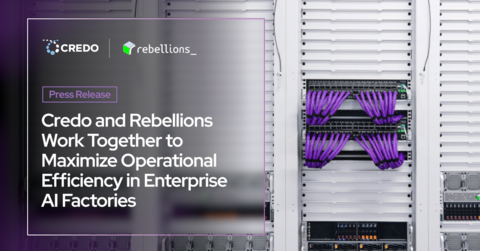
Credo Technology Group Holding Ltd (NASDAQ: CRDO) and Rebellions are integrating connectivity and AI inference technologies to improve operational efficiency in enterprise-scale AI systems.
The integration brings Credo’s ZeroFlap active electrical cables into Rebellions’ RebelPOD AI infrastructure. The companies said the combined setup is designed to support scalable AI “factories” by improving network stability and reducing downtime in high-performance computing environments.
RebelPOD is a production-ready AI inference platform built for large enterprise deployments. It supports distributed workloads across high-utilization clusters, where consistent latency and uninterrupted availability are critical to system performance.
The companies noted that even brief connectivity disruptions can slow inference processing, increase queue times, and degrade user experience. ZeroFlap AECs are designed to eliminate link instability and reduce the need for manual intervention in complex AI networks.
Credo’s ZeroFlap cables are built for high-reliability interconnect performance in backend AI networks. The company said the technology has accumulated billions of operating hours in production environments without link flap events.
Bill Brennan said AI inference systems must be designed for both performance and continuous uptime at scale.
He said integrating ZeroFlap technology into Rebellions’ architecture enables enterprises to deploy AI infrastructure with higher reliability, faster setup, and improved operational stability.
Sunghyun Park said the focus is on simplifying AI infrastructure deployment for enterprise customers.
He said reducing infrastructure complexity helps organizations adopt AI inference systems more quickly while lowering operational risk.
RebelPOD includes rack-to-rack scalability and RDMA networking to support distributed AI workloads. The system is designed for large-scale inference environments where efficiency and stability are essential.
The integration of Credo’s connectivity technology is expected to improve system resilience across these deployments, particularly in always-on AI environments requiring continuous model execution and high throughput.
Industry observers note that AI inference is increasingly shifting toward large-scale, persistent infrastructure deployments. This shift is placing greater emphasis on network reliability, latency consistency, and operational efficiency across AI clusters.
The companies said the combined solution supports enterprise customers building AI factories that require predictable performance at scale as demand for real-time AI applications continues to expand.
Credo said its ZeroFlap AEC technology is widely deployed in AI backend networks to reduce disruptions and simplify maintenance in large-scale systems.