

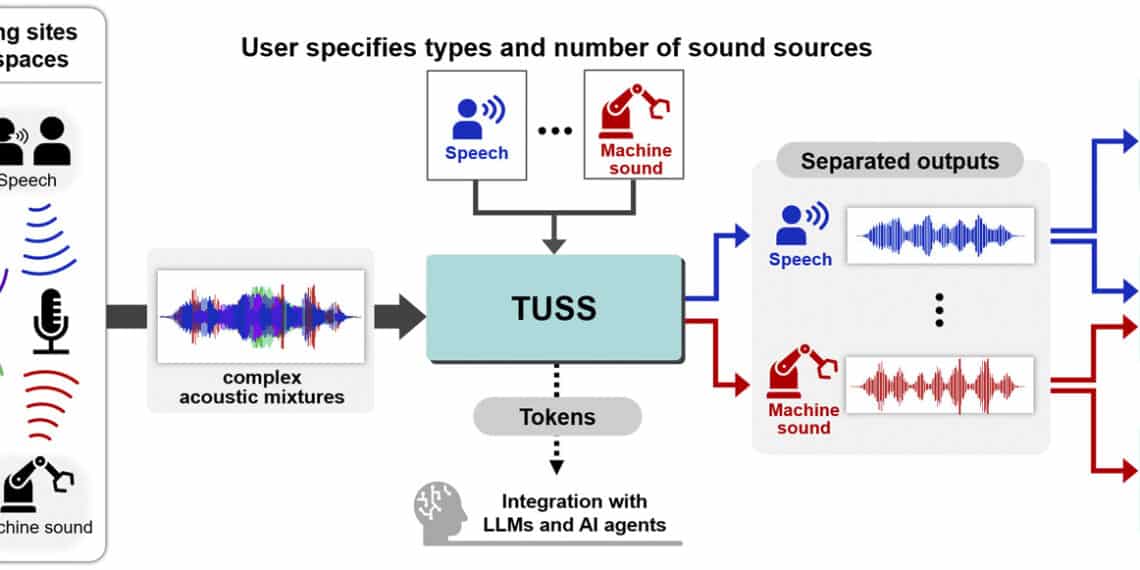
Mitsubishi Electric Corporation (TOKYO: 6503) has developed a new artificial intelligence technology designed to help physical AI systems distinguish specific sounds from complex acoustic environments, potentially improving their ability to understand events in manufacturing facilities and public spaces.
The company said its Task-Aware Unified Source Separation (TUSS) technology uses a single AI model to separate and extract targeted sounds from mixed audio. Mitsubishi Electric Research Laboratories (MERL) in Cambridge, Massachusetts, jointly developed the technology with Mitsubishi Electric.
Sound is becoming an increasingly important input for physical AI applications. Industrial systems can use audio for anomaly detection, while voice-controlled equipment and on-site monitoring systems can rely on speech and environmental sounds to interpret situations. In noisy environments, however, machinery, conversations and other background sounds can overlap, making it difficult for AI systems to identify the information they need.
TUSS addresses this challenge by using prompts to specify the type and number of sound sources that should be separated or extracted. Mitsubishi Electric said the approach allows one AI model to handle multiple sound-separation tasks, including speech separation, speech enhancement and extraction of environmental sounds.
The unified approach could reduce the need to develop separate source-separation models for different applications and sound types. It also allows systems to adapt to changing acoustic conditions and operational requirements.
The technology can be connected to downstream AI applications such as anomaly detection, speech recognition, voice-controlled equipment and operational recordkeeping. By isolating relevant audio signals before processing them, these systems can potentially obtain clearer information from environments where multiple sound sources are present simultaneously.
The development comes as manufacturers explore physical AI systems capable of perceiving and responding to real-world environments. Unlike software systems operating primarily on digital information, physical AI applications must interpret inputs such as sound, vision and sensor data to make decisions in physical settings.
Mitsubishi Electric will demonstrate the technology at CEATEC 2026, scheduled for October 13-16 at Makuhari Messe in Japan. The demonstration, titled “Ear of Physical AI: Distinguishing Diverse Sounds, from Machine Anomalies to Human Voices,” will use mixed audio captured at the exhibition venue.
The live demonstration will combine sounds from machinery, musical instruments and multiple speakers. Visitors will be able to see the system separate individual sound sources based on prompts and use the extracted signals for applications including speech recognition and abnormal-sound diagnosis.
The company’s demonstration is aimed at showing how task-specific audio extraction could support AI systems operating in environments where sound conditions are unpredictable and multiple signals compete for attention.
For Mitsubishi Electric, the technology adds an audio-processing capability to the broader development of AI-enabled industrial and mobility systems. Its ability to use a single model across different sound-separation tasks could also simplify deployment as the range of physical AI applications expands.