

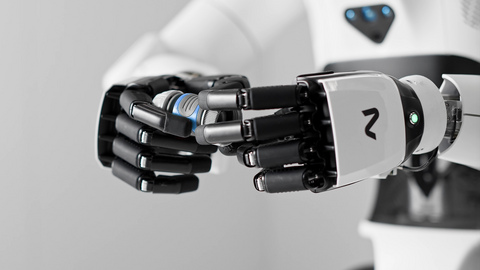
NEURA Robotics has introduced Neuron AI, a multimodal foundation model designed to help robots understand their environments and carry out physical tasks. Developed in Metzingen, Germany, the model combines inputs such as 3D vision, tactile and force sensing, audio, robot-state data and language to support perception, reasoning and action.
The launch reflects the company’s approach to Physical AI, which focuses on enabling machines to interpret real-world conditions and respond through physical actions. Unlike AI systems designed primarily for text or digital environments, Neuron AI is intended to connect environmental perception with robot movement and task execution.
The model uses a Perception-Language-Action architecture, linking information gathered through sensors with language-based interpretation and physical responses. NEURA says this approach allows robots to respond to changing conditions and account for objects and events beyond their immediate field of view.
Neuron AI: Product Specifications and Capabilities
| Specification | Details |
|---|---|
| Product | Neuron AI |
| Product category | Multimodal foundation model for Physical AI |
| Developer | NEURA Robotics |
| Development location | Metzingen, Germany |
| Architecture | Perception-Language-Action |
| Input modalities | 3D vision, tactile and force sensing, audio, robot-state data and language |
| Training approach | Real-world robot data, simulated data and human demonstrations |
| Training infrastructure | NEURA Gyms, Data Amplifier and the company’s simulation stack |
| Robot compatibility | Designed for use across five robot embodiments, according to the company |
| Deployment ecosystem | Neuraverse |
| Announced applications | Object handling, grasping, interpreting environmental sounds and industrial tasks such as welding |
| Planned demonstration | NVIDIA GTC Berlin 2026, featuring the 4NE1 humanoid robot |
Note: The company announcement does not specify the model’s parameter count, benchmark scores, hardware requirements, pricing or general availability.
Connecting Perception With Physical Action
Neuron AI is designed to combine multiple streams of information rather than rely on a single sensor or input type. Its architecture integrates visual observations with tactile feedback, audio cues, language and information about the robot’s own state.
This combination is intended to help robots interpret situations that require more than visual recognition. The company cites examples such as operating locks, grasping objects that are no longer in view and using sound to inform tasks such as welding.
The model also incorporates memory-related capabilities, including object permanence. This enables a robot to account for an object even when it is temporarily outside its field of vision, supporting tasks that involve movement, occlusion and changing surroundings.
These capabilities are relevant to environments where robots must interact with physical objects and respond to conditions that may not be fully predictable in advance. Their practical performance, however, will depend on the specific task, robot configuration and operating environment.
Training Across Real and Simulated Environments
NEURA Robotics says Neuron AI is trained using a combination of real-world data collected through its NEURA Gyms, simulated data generated through its Data Amplifier and simulation stack, and human demonstrations captured using sensor suits.
The combination is intended to expose the model to different tasks and physical situations. Real-world data provides observations from actual robot interactions, while simulation can support training across scenarios that may be difficult or costly to reproduce repeatedly in physical environments. Human demonstrations provide additional examples of task execution.
The company says Neuron AI is designed to operate across five robot embodiments. Using a shared model across different platforms could help extend learned capabilities across robot types, although the announcement does not provide comparative performance results or details on the adaptations required for individual embodiments.
Deployment Through the Neuraverse
NEURA Robotics plans to use Neuraverse as the deployment ecosystem for its robot models. According to the company, the platform will support fleet deployment, fine-tuning and the creation of private robot skills. Users may also voluntarily share skills within the ecosystem.
This approach connects model development with deployment and subsequent adaptation. Fine-tuning can help tailor a model to particular tasks, while fleet deployment can provide a way to distribute updates across compatible robots. The announcement does not detail the commercial terms, data-governance arrangements or availability of these capabilities.
NEURA Robotics also identifies industrial data partnerships with Schaeffler and Bosch as part of its broader development work. Such partnerships are relevant to Physical AI because industrial environments present varied equipment, processes and operating conditions. The announcement does not quantify how much partner data contributes to Neuron AI’s training.
Humanoid Demonstration Planned for GTC Berlin
NEURA Robotics plans to demonstrate Neuron AI at NVIDIA GTC Berlin 2026. The company says its 4NE1 humanoid robot will perform an 11-minute laundry-handling sequence, illustrating the model’s intended application to a multistep household task.
The demonstration is expected to show how perception and action can be coordinated across a sequence of physical interactions. Laundry handling can involve identifying garments, picking them up, repositioning them and responding to changes in how the items are arranged.
The planned demonstration will offer a practical example of the system’s capabilities. However, a controlled demonstration alone would not establish how reliably the model performs across different homes, objects or operating conditions.