

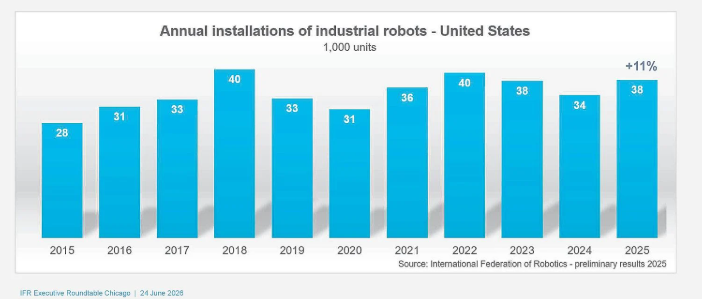
Industrial robot installations in the United States increased 11% year-on-year to 38,000 units in 2025, marking a return to double-digit growth as businesses expanded automation investments across a broader range of industries, according to preliminary results released by the International Federation of Robotics (IFR).
The recovery was driven by strong demand from the food industry and other non-manufacturing sectors, highlighting a shift in automation adoption beyond traditional industrial applications.
“The United States are back on the growth track,” said Takayuki Ito, President of the International Federation of Robotics. He noted that while the automotive sector delivered its third-best performance in seven years, the strongest momentum came from the food industry, where robot adoption surged 30% compared with the previous year.
Despite the diversification of demand, automotive remained the largest adopter of industrial robots in the country. The sector installed 13,500 units in 2025, only 1% below the previous year’s level.
The food industry emerged as one of the fastest-growing automation markets, reaching installation levels comparable to the metal and machinery sector and the electrical and electronics industry. Each of these sectors recorded around 3,000 robot installations during the year.
The report also showed improvements in the United States’ global automation ranking. Robot density, a key indicator of manufacturing automation measured by the number of industrial robots per 10,000 manufacturing workers, rose to 307 units. This moved the United States to eighth place globally, up two positions from the previous year.
However, the country continues to trail several major industrial economies. According to IFR data, robot density stands at 1,220 units in South Korea, 449 in Germany, and 446 in Japan. The United States remains ahead of China on this metric, where robot density is reported at 166 units.
While the United States is seeing renewed growth, China continues to dominate the global robotics market in terms of scale. Annual robot installations in China reached 295,000 units in 2024, accounting for 54% of global demand. IFR estimates that China’s 2025 installations are likely to be about ten times higher than those recorded in the United States.
The federation attributed China’s growth to a decade-long national robotics strategy and continued government support. The country’s latest Five-Year Plan for 2026-2030 places robotics at the center of industrial modernization efforts and emphasizes the development of AI-powered physical systems.
In the United States, policymakers and industry groups are also pushing for stronger support for robotics adoption. North America’s largest automation association, the Association for Advancing Automation (A3), recently unveiled its “Vision for a National Robotics Strategy.” The proposal calls for the creation of a Federal Robotics Office and a National Commission to coordinate research, workforce development, safety standards, and public-private partnerships.
Looking ahead, IFR said the outlook for automation in the United States and broader North American market remains positive. Manufacturers continue to face labor shortages, while reshoring initiatives are increasing demand for automated production systems. As adoption expands beyond automotive into food processing, logistics, and other industries, the federation expects sustained long-term growth for the region’s robotics sector.