

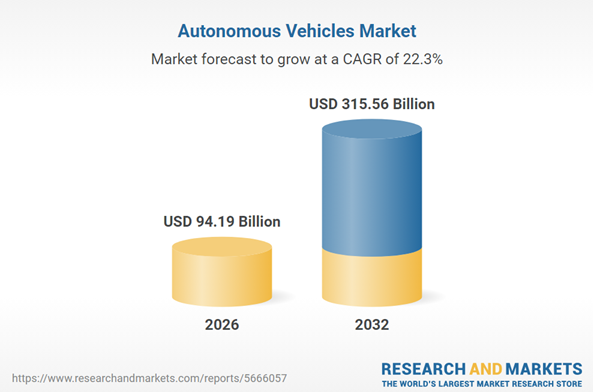
The global autonomous vehicle market is expected to more than triple over the next six years, reaching US$315.56 billion by 2032 from an estimated US$94.19 billion in 2026, according to the latest Autonomous Vehicles Market – Global Forecast 2026–2032 report by ResearchAndMarkets.com. The market is forecast to expand at a compound annual growth rate (CAGR) of 22.25%, driven by advances in artificial intelligence, software-defined vehicle architectures, connected infrastructure and the growing commercial deployment of autonomous systems across multiple industries.
While fully autonomous passenger vehicles continue to attract attention, the industry’s strongest momentum is emerging in commercial and industrial environments where operational conditions are more predictable. Warehouses, ports, mines, logistics hubs, campuses, agricultural operations and fixed-route public transport systems are increasingly becoming the primary testing grounds for autonomous technologies, enabling companies to validate safety, improve efficiency and reduce operating costs before broader deployment on public roads.
The report highlights that the autonomous vehicle ecosystem has evolved significantly from its early focus on hardware innovation. Today’s market is increasingly centred on software platforms capable of integrating artificial intelligence, advanced driver assistance systems (ADAS), sensor fusion, high-definition mapping, vehicle-to-everything (V2X) communications, edge computing and cybersecurity into a unified mobility architecture. Software-defined vehicles, supported by over-the-air updates and centralised computing, are allowing manufacturers to continuously improve vehicle performance after deployment, reducing development cycles and extending product capabilities.
Artificial intelligence has emerged as the core technology enabling this transformation. AI systems process data from cameras, lidar, radar, ultrasonic sensors and thermal imaging to perceive surroundings, identify road users, predict traffic behaviour and make real-time driving decisions. The report notes that AI also plays a critical role in localisation, route planning, driver monitoring, fleet management and simulation-based validation, making it indispensable for both autonomous driving and advanced driver assistance technologies.
A growing reliance on simulation is also reshaping vehicle development. Because rare driving scenarios occur infrequently in real-world testing, companies are increasingly using digital twins, synthetic data generation and large-scale virtual simulations to expose autonomous systems to millions of complex traffic, weather and lighting conditions. These tools enable developers to improve perception models, validate safety performance and accelerate regulatory approval while reducing development costs.
Several structural trends continue to support market expansion. Rising concerns over road safety, labour shortages in logistics and public transport, rapid growth in e-commerce deliveries, increasing urban congestion and ageing populations requiring more accessible mobility solutions are driving investment in autonomous transportation technologies. At the same time, electrification initiatives, intelligent transport systems and smart city programmes are creating connected infrastructure capable of supporting autonomous mobility at scale.
Despite the market’s strong growth outlook, significant challenges remain before widespread deployment becomes a reality. The report identifies safety validation, regulatory compliance, liability frameworks, cybersecurity risks, adverse weather conditions and public trust as key barriers. Supply chain resilience for semiconductors, sensors, compute platforms and other critical electronic components also remains an important consideration for manufacturers seeking to scale production.
Rather than pursuing universal full autonomy across every driving environment, industry participants are increasingly focusing on domain-specific applications. Geofenced operations, supervised autonomous driving and incremental automation are becoming the preferred commercial strategy, allowing developers to deploy systems in controlled environments where safety risks can be managed more effectively while generating measurable business value.
Regionally, Asia-Pacific continues to lead autonomous vehicle development, supported by advanced electronics manufacturing, widespread 5G deployment, strong government backing and large-scale smart mobility initiatives. China has established extensive autonomous driving test zones and intelligent transport infrastructure, while Japan and South Korea continue to leverage their strengths in automotive engineering, robotics and semiconductor technologies. India presents significant long-term opportunities driven by logistics modernisation, digital infrastructure expansion and road safety initiatives, although highly heterogeneous traffic conditions require locally adapted AI models and deployment strategies.
North America remains a major innovation hub for autonomous mobility, with the United States leading development in robotaxi services, autonomous trucking, AI software platforms and state-level regulatory testing programmes. Canada contributes through artificial intelligence research, connected infrastructure initiatives and cold-weather testing, while Mexico’s automotive manufacturing base positions it to benefit from automated freight and industrial mobility applications.
Europe continues to advance autonomous mobility through a combination of stringent safety regulations, sustainability policies and strong automotive engineering expertise. Countries including Germany, France and the United Kingdom are expanding testing corridors, connected mobility pilots and automated public transport programmes. The European Union is also playing an influential role in establishing harmonised standards covering cybersecurity, vehicle safety, data protection and cross-border interoperability.
Elsewhere, adoption is progressing according to regional priorities. Australia is focusing on autonomous mining, agriculture and long-distance freight operations, while Latin America is concentrating on logistics corridors, mining automation and fleet management. Gulf nations are investing in autonomous shuttles, smart transport systems and connected urban mobility as part of broader smart city initiatives. In Africa, early adoption is centred on mining, agriculture and industrial automation, with advanced driver assistance and remote monitoring expected to precede widespread deployment of fully autonomous vehicles.
Artificial intelligence will continue to define the next phase of autonomous mobility, but the report notes that governance will become equally important. Developers must address AI explainability, data bias, cybersecurity, sensor reliability and privacy concerns while building robust safety cases that satisfy increasingly demanding regulatory requirements. Future deployments are expected to rely on multiple layers of redundancy, remote assistance capabilities, continuous monitoring and post-incident traceability to ensure safe operation.
Looking ahead, the report suggests the competitive landscape will increasingly favour companies capable of combining high-quality driving data, AI model development, mapping accuracy, simulation capabilities and commercially viable deployment strategies. Leadership will no longer depend solely on vehicle engineering but also on the ability to integrate autonomous technologies into broader digital mobility ecosystems supported by connected infrastructure, cloud computing and intelligent transport networks.