


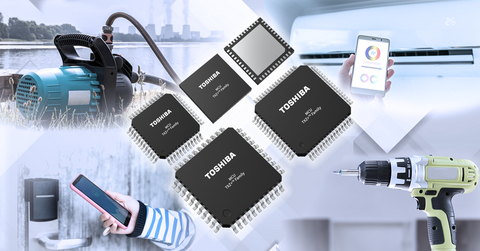
Toshiba Electronic Devices & Storage Corporation has started mass production of a new series of compact microcontrollers designed for single-motor control applications, targeting next-generation home appliances, consumer electronics and industrial equipment with enhanced processing, security and functional safety capabilities.
The new TXZ+ Family Entry Class M4L Group is built around the Arm Cortex-M4 processor with a floating-point unit (FPU), offering processing speeds of up to 80MHz while integrating dedicated motor-control hardware intended to improve system efficiency and reduce processor workload.
The launch comes as manufacturers increasingly seek energy-efficient, connected and compact products that support IoT functionality, predictive maintenance and more sophisticated motor control. These trends have driven demand for microcontrollers capable of delivering higher precision while simplifying system design.
According to Toshiba, the new devices integrate motor-control hardware, security functions and functional safety features onto a single chip, enabling precise motor operation without placing the entire processing burden on the CPU.
By offloading motor-control tasks to dedicated hardware, the microcontrollers can improve processing efficiency while maintaining accurate control of single-motor systems used across household appliances, consumer products and industrial automation equipment.
The microcontrollers support an operating voltage range of 2.7V to 5.5V, allowing compatibility with existing 3V and 5V system designs while providing flexibility for new product development. Toshiba is offering the devices in four compact package options ranging from 44 to 64 pins, along with 128KB and 256KB memory variants to accommodate different application requirements.
To help reduce system complexity, the chips integrate a high-speed oscillator with ±1% accuracy and an overcurrent detection comparator capable of initiating emergency motor shutdown, reducing the need for external components and enabling more compact circuit board designs.
The devices also feature a STOP2 low-power mode, making them suitable for battery-powered products where energy efficiency is a key design consideration.
For applications requiring firmware updates, the 256KB versions incorporate dual-bank flash memory with two 128KB blocks. This architecture allows one memory bank to execute application code while the second bank is rewritten, enabling firmware updates without interrupting system operation and supporting over-the-air (OTA) software upgrades.
Meanwhile, the 128KB models include 64KB of data flash memory designed for storing configuration settings and operational logs.
Security features integrated into the new microcontrollers include Chip Protection (CPRO), Secure Access Memory (SAM) and Non-Rewritable Flash Protection (NRFP), which are intended to prevent unauthorised access, protect critical firmware and strengthen security for connected IoT devices.
The devices also incorporate a range of communication interfaces, including UART, SPI, I²C and a Serial Memory Interface (SMIF) for external memory connectivity, supporting integration into a broad range of embedded systems.
To address safety requirements, Toshiba has integrated diagnostic functions capable of detecting abnormalities in flash memory, RAM, analogue-to-digital converters and clock systems. The company also provides software certified to UL 60730 Class B, a functional safety standard widely used for household appliances, helping manufacturers streamline product certification.
Alongside the new microcontrollers, Toshiba said it will provide documentation, sample software, driver packages, evaluation boards and development environments through collaborations with Arm ecosystem partners. The company plans to continue expanding its portfolio of motor-control microcontrollers as demand grows for compact, connected and energy-efficient embedded systems across consumer and industrial markets.