


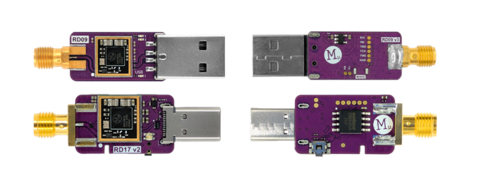
Morse Micro has announced two Wi-Fi HaLow USB dongle reference designs aimed at bringing long-range wireless connectivity to existing devices through a standard USB connection, potentially widening the technology’s use across industrial, enterprise and edge computing applications.
The designs, MM8108-RD09 and MM8108-RD17, are built around the company’s MM8108 system-on-chip (SoC). Morse Micro said the reference designs can enable Wi-Fi HaLow connectivity on existing hardware without requiring manufacturers to develop entirely new platforms.
Wi-Fi HaLow, based on the IEEE 802.11ah standard, is designed for longer-range and lower-power wireless connectivity than conventional Wi-Fi. Morse Micro said its networks can provide native IP connectivity across distances of up to one kilometre, depending on deployment conditions.
The MM8108-RD09 is designed to add Wi-Fi HaLow connectivity to access points and client devices. OpenWRT drivers are available for routers and access points equipped with USB interfaces. For client hardware, Morse Micro is providing native Windows and Linux drivers alongside a macOS application, allowing users to connect to Wi-Fi HaLow networks through familiar networking interfaces.
The second design, MM8108-RD17, takes a different approach by reducing dependence on host-device drivers. When connected, the dongle appears to the host as a standard CDC-NCM Ethernet interface. This allows it to add Wi-Fi HaLow connectivity to a broader range of products, including industrial computers, robotics platforms, point-of-sale terminals, tablets and smartphones running Android or iOS.
The RD17 design also supports device authentication through Wi-Fi Easy Connect, or Device Provisioning Protocol (DPP), using a pairing button. This could simplify deployment in environments where numerous connected devices need to be provisioned.
The reference designs target applications where conventional wireless connectivity may face range or deployment constraints. Industrial facilities, large properties and distributed edge systems are among the potential use cases for longer-range IP connectivity.
Michael De Nil, co-founder and CEO of Morse Micro, said the USB designs are intended to accelerate Wi-Fi HaLow adoption by allowing existing equipment to gain long-range connectivity without major hardware changes.
According to De Nil, the RD09 could allow internet service providers to upgrade existing wireless routers with kilometre-range Wi-Fi capabilities, while the RD17 could connect existing laptops, phones and tablets across larger properties without requiring additional software updates.
Morse Micro said schematics and software for both reference designs are available to tier-one customers through its sales representatives.