


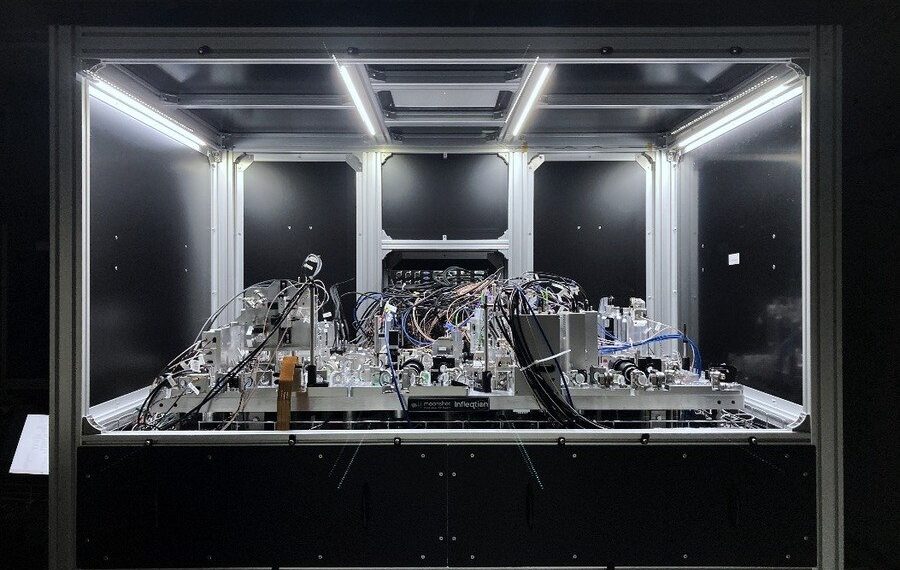
Infleqtion (NYSE: INFQ) has supported the launch of Japan’s first operational full-stack neutral-atom quantum computer, marking a milestone for the country’s quantum computing program and its collaboration with the U.S.-based quantum technology company.
The system, known as “Shunkai,” was developed by a research team led by Professor Kenji Ohmori at the Institute for Molecular Science (IMS), part of Japan’s National Institutes of Natural Sciences. Infleqtion supplied the quantum processing unit for the project.
The collaboration is part of Japan’s Quantum Moonshot program, administered by the Japan Science and Technology Agency (JST). Infleqtion said it was the only foreign quantum technology partner selected by JST for the program.
Shunkai is initially expected to operate with about 50 qubits, with plans to expand to roughly 500 qubits as development progresses. The system’s transition from research and development into operational use represents an important step in Japan’s efforts to build more advanced quantum computing infrastructure.
“This milestone marks a pivotal moment for Japan’s quantum ambitions as well as Infleqtion’s role in advancing production-ready quantum platforms at scale,” said Pranav Gokhale, chief technology officer at Infleqtion.
He said operating a full-stack quantum system could help advance work toward fault-tolerant quantum computing while providing a demonstration of the scalability and control possible with neutral-atom architectures.
Neutral-atom systems use individual atoms as quantum bits and manipulate them using techniques such as lasers. The architecture has attracted attention because it can potentially support large numbers of qubits while maintaining high levels of control over the quantum states.
The next stage of the Ohmori Moonshot project began in April 2026. Researchers at IMS will focus on improving system integration, stability and scalability, with a longer-term goal of developing a neutral-atom quantum computer capable of supporting up to 10,000 physical qubits.
The project also plans to incorporate quantum error detection and correction capabilities, which are considered essential for building fault-tolerant quantum systems capable of performing reliable computations at scale.
As part of the program, the system is expected to become available to external users. That access could allow researchers and companies to develop quantum applications and conduct further research into quantum error correction.
For Infleqtion, the deployment provides a high-profile demonstration of its neutral-atom quantum processing technology in an operational environment. For Japan, the project represents another step in building domestic quantum computing capabilities through collaboration between academic researchers and international technology providers.
The development comes as governments and technology companies increase investment in quantum computing, with competing architectures including superconducting circuits, trapped ions and neutral atoms being developed toward practical applications.
The ability to scale qubit counts while improving reliability remains a central challenge across the industry. The progression of Shunkai from an initial 50-qubit system toward larger configurations will therefore provide a practical test of the neutral-atom approach and its potential role in Japan’s longer-term quantum computing strategy.