

Semtech Corporation (Nasdaq: SMTC) has launched a new family of 224G linear transimpedance amplifier (TIA) and driver solutions aimed at accelerating the deployment of near-packaged optics (NPO) and co-packaged optics (CPO) in AI clusters, hyperscale data centers and next-generation networking systems.
The company introduced the portfolio as AI workloads continue to push data center networks toward higher bandwidth, greater power efficiency and increased optical density. Semtech said its new devices are designed to address challenges involving power consumption, thermal management, signal integrity and system density as optical connectivity moves closer to switching and compute silicon.
The launch comes as NPO and CPO architectures begin moving toward broader deployment. By positioning optical interfaces closer to the switching silicon, the architectures are designed to shorten high-speed electrical connections and support higher bandwidth density while helping manage system-level power and thermal constraints.
“Near-packaged and co-packaged optics are entering their initial ramp in 2026,” said Sameh Boujelbene, vice president, data center switch and AI networks market research at Dell’Oro Group. He said TIA and driver technology will become increasingly important as hyperscalers move these architectures from trials into deployment.
224G Devices Target Next-Generation Optical Engines
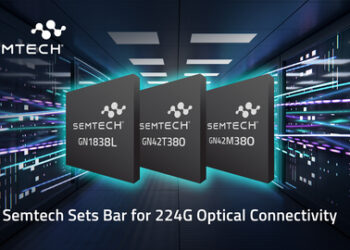
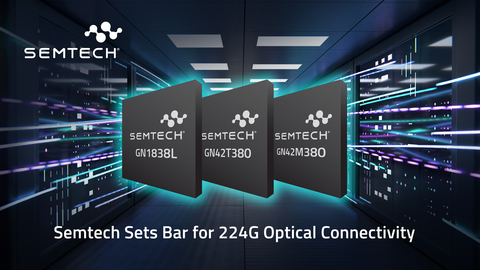
Semtech’s new portfolio includes the GN1838L and GN42T380, which the company describes as the industry’s first linear octal TIAs, along with the GN42M380 linear octal Mach-Zehnder Modulator (MZM) driver.
The devices are designed for optical engines supporting 1.6T, 3.2T, 6.4T and 12.8T configurations and are optimized for CEI-224G-Linear and Open CPX interfaces.
The portfolio targets linear optical architectures with stringent requirements for power dissipation, physical space and signal performance.
“At 224G per lane, designers need more than bandwidth,” said Amit Thakar, vice president of signal integrity product marketing at Semtech. He said the devices are designed to provide signal integrity, power efficiency and flexibility for NPO and CPO developers.
The GN1838L features a 500-micron channel pitch, while the GN42T380 uses a 375-micron pitch. Semtech said the two TIAs can support different optical engine configurations, including side-by-side placement with a photonics integrated circuit (PIC) or direct placement on top of the PIC.
Both TIAs incorporate automatic gain control and output drivers with programmable continuous-time linear equalization. They support manual and automatic gain control modes and include programmable output equalization.
Semtech said the devices are designed to achieve low peaking and input-referred noise, controlled group delay and low distortion while supporting a range of optical input signals.
| Product | Type | Channel Pitch | Key Applications / Support |
|---|---|---|---|
| GN1838L | Linear Octal TIA | 500 µm | 1.6T–12.8T optical engines; NPO/CPO |
| GN42T380 | Linear Octal TIA | 375 µm | 1.6T–12.8T optical engines; NPO/CPO |
| GN42M380 | Linear Octal MZM Driver | 375 µm | SiPh, InP MZM and TFLN modulators |
| Portfolio | 224G Linear TIA & Driver | 375–500 µm | CEI-224G-Linear, Open CPX; AI/ML data centers |
Driver Supports Multiple Photonics Platforms
The GN42M380 driver also uses a 375-micron channel pitch and is designed to support multiple modulator technologies, including silicon photonics, indium phosphide Mach-Zehnder modulators and thin-film lithium niobate.
The device features programmable continuous-time linear equalization to compensate for intersymbol interference in the input signal path. It also provides configurable output swing and flexible biasing to support Mach-Zehnder modulators from different vendors.
Semtech said the driver is designed to deliver low group delay and low total harmonic distortion, while on-chip equalization allows designers to tune electrical and optical performance.
The company has also incorporated diagnostics and performance-tuning capabilities across the TIA and driver family. These functions can be accessed through device pads and an I²C interface.