


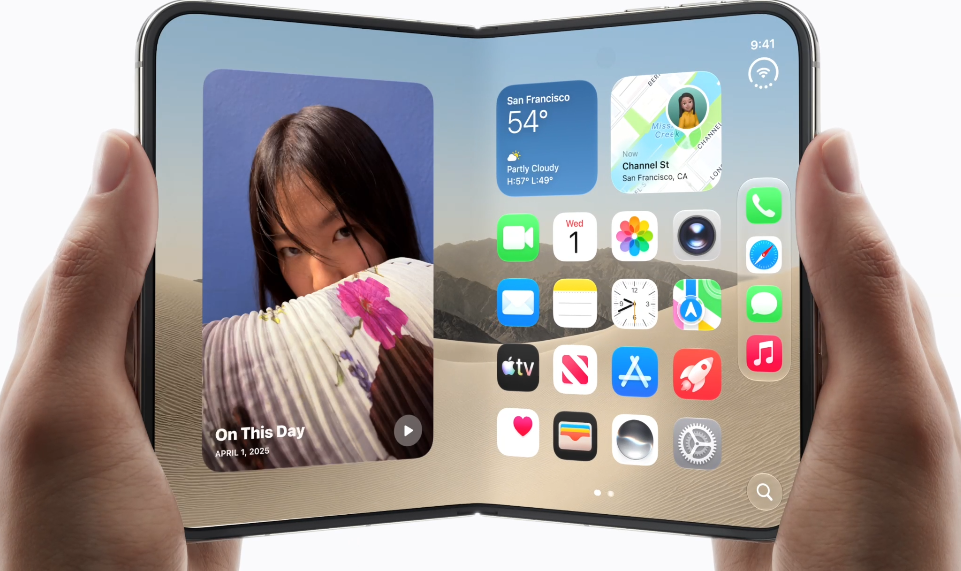
Apple (Nasdaq: AAPL) has entered the foldable smartphone market with the launch of iPhone Duo, introducing a two-display design that combines a 7.6-inch inner screen with a 5.4-inch outer display.
The device, unveiled September 9, is positioned as Apple’s first foldable iPhone and marks one of the company’s biggest hardware changes to the iPhone lineup since its introduction. Apple is combining the foldable form factor with its latest A20 Pro chip, dual-battery architecture, custom thermal system and iOS 27 software.
iPhone Duo starts at $1,999 in the US for 256GB of storage. Pre-orders begin October 16, with availability starting October 23 in more than 70 countries and regions, including the US and India.
iPhone Duo Specifications at a Glance
| Specification | iPhone Duo |
|---|---|
| Inner display | 7.6-inch Super Retina XDR |
| Outer display | 5.4-inch Super Retina XDR |
| Display features | ProMotion, Always On, up to 3,000 nits |
| Processor | A20 Pro |
| CPU | 6-core |
| GPU | 7-core |
| Neural Engine | Dual 16-core |
| Main camera | 48MP Fusion |
| Ultra Wide | 48MP Fusion |
| Video | Up to 4K at 120 fps, Dolby Vision |
| Materials | Grade 5 titanium |
| Water/dust resistance | IP68 |
| Wireless | Wi-Fi 7, Bluetooth 6, Thread |
| Cellular | C2 modem, mmWave in US |
| Storage | 256GB, 512GB, 1TB, 2TB |
| Battery | Dual-battery architecture |
| Colors | Star White, Night Sky |
| Starting price | $1,999 |
| Availability | October 23, 2026 |
A Foldable Design Built Around Two Displays
The central feature of iPhone Duo is its foldable architecture. When closed, the device uses a 5.4-inch outer Super Retina XDR display. Apple says that screen provides 90% of the screen area of the iPhone 18 Pro while maintaining a compact form factor.
Opening the device reveals a 7.6-inch inner Super Retina XDR display, which Apple says is 50% larger than the display on the iPhone 18 Pro Max.
Both screens use the same aspect ratio, allowing content to scale proportionally as users move between the folded and unfolded configurations. The displays also support ProMotion, Always On functionality and up to 3,000 nits of peak outdoor brightness.
Apple has applied a nano-texture finish to the inner display to reduce glare and reflections. A hidden FaceTime camera sits beneath the inner display, allowing the screen to remain uninterrupted.
Later this year, iPhone Duo will also support Apple Pencil with USB-C on both displays.
Titanium Construction and a Multi-Part Hinge
Apple has built the enclosure from Grade 5 titanium and paired it with Ceramic Shield protection. The front uses Ceramic Shield 2, which Apple says provides three times better scratch resistance than the previous generation.
The hinge contains more than 100 components and is designed to control the opening and closing motion while supporting the center of the display. Internal support ribs reinforce the structure, while ceramic fiber inserts around the antenna splits add rigidity.
The folding display itself uses several protective layers, including high-strength glass, a custom polymer nano-textured cover and a titanium plate beneath the panel. Apple says the polymer has up to 40% higher stiffness than other materials used in the industry.
The device carries an IP68 rating for splash, water and dust resistance under controlled laboratory testing.
48MP Dual Fusion Camera System
Apple has also redesigned the camera experience around the foldable form factor.
The main camera is a 48MP Fusion sensor capable of capturing images at up to 48MP resolution, with a 24MP default mode designed to balance image quality and file size. It also provides an integrated optical-quality 2x telephoto capability.
A second 48MP Fusion Ultra Wide camera supports wider shots and macro photography. The system also includes a Center Stage front camera capable of automatically adjusting framing across orientations.
Camera Specifications
| Camera Feature | Details |
|---|---|
| Main camera | 48MP Fusion |
| Ultra Wide | 48MP Fusion |
| Telephoto | Optical-quality 2x |
| Front camera | Center Stage |
| Video | 4K at 120 fps, Dolby Vision |
| Cinematic mode | Up to 60 fps after capture |
| Time-lapse | 4K Dolby Vision HDR |
| Stabilization | Sensor-shift optical image stabilization |
The folding architecture enables several camera features that depend on the second display. Smart Take uses on-device AI models running on A20 Pro to analyze a scene and capture an image when subjects are ready.
Users can also use the outer screen as a preview when taking selfies with the rear cameras. Duo Preview allows subjects to see the live camera feed, while Kid Cue uses animations on the outer display to attract a child’s attention.
The device can also be propped up for hands-free video calls and longer-duration video capture.
iOS 27 Adds Foldable-Specific Multitasking
Apple has redesigned iOS 27 to accommodate the two-screen configuration.
When the phone is open, the interface can place controls and navigation elements along the sides to preserve vertical screen space. The Home Screen can display two pages alongside Today View, while the Dynamic Island adapts to the orientation of the inner and outer displays.
Multitasking is a major focus. Split View allows two applications to run side by side, while users can switch between applications, open two windows of the same app and interact with Siri AI while viewing other content.
Apple said applications from Netflix, Zoom and Slack are already being adapted for the foldable format. Developers can use updated APIs and SDK support to build applications around the new display configuration.
StandBy also works on either screen, allowing the unfolded or closed device to function as a clock, photo frame or widget hub.
A20 Pro Targets Sustained Performance
iPhone Duo is powered by Apple’s A20 Pro chip, the same processor used in the iPhone 18 Pro models.
Apple says the device delivers up to 35% better sustained performance than the iPhone 17 Pro. The chip uses a package design inspired by Apple’s M-series processors and connects directly to a custom vapor chamber designed to dissipate heat.
| Performance Component | Specification |
|---|---|
| CPU | 6-core, up to 20% faster than A19 Pro |
| GPU | 7-core, up to 40% faster and more power efficient |
| Neural Engine | Dual 16-core |
| Neural compute | 2x compute power |
| Memory bandwidth | 50% higher |
| Manufacturing | 2nm process |
| Thermal system | Custom vapor chamber |
A new display engine drives both screens simultaneously, while the thermal architecture is intended to maintain performance during gaming, multitasking and AI workloads.
Dual Batteries Target Foldable Power Demands
The internal architecture uses a battery on each side of the device. Apple says its silicon and energy-rebalancing algorithms allow the two batteries to operate as a single system.
The company rates iPhone Duo for up to 31 hours of video playback when using the inner display and up to 44 hours when using the outer display. With equal use of both displays, Apple says typical usage can reach 24 hours per charge.
Wired charging can reach 50% in about 20 minutes under Apple’s specified testing conditions. MagSafe or Qi2 charging can reach 50% in about 30 minutes.
Apple Puts AI at the Center of the Experience
iPhone Duo launches with Apple Intelligence and iOS 27, while Siri AI is rolling out in beta.
Siri AI is designed to use personal context from information such as messages, emails and photos, while onscreen awareness allows it to respond to content displayed on the device. Apple is also introducing a dedicated Siri app for accessing conversation history.
Other Apple Intelligence features include AI-assisted image editing, Image Playground and additional tools for working with content.
Apple says its AI processing combines on-device computation with Private Cloud Compute. Siri AI initially supports English, with additional languages planned for October. Some AI capabilities will have regional and language restrictions, including initial restrictions in the European Union.
Connectivity Moves to eSIM and Apple’s New Chips
iPhone Duo uses an eSIM-only design worldwide, allowing Apple to use internal space otherwise occupied by a physical SIM system.
The device includes Apple’s N1 wireless networking chip, which supports Wi-Fi 7, Bluetooth 6 and Thread. Apple’s C2 cellular modem adds AI-powered improvements to cellular performance and supports mmWave in the US.
The phone also supports iPhone Handoff, allowing users with supported carriers to switch between two iPhone models using the same phone number.
Pricing, Accessories and Availability
iPhone Duo will be sold in Star White and Night Sky with 256GB, 512GB, 1TB and 2TB storage options.
| Model | US Starting Price |
|---|---|
| 256GB | $1,999 |
| 512GB | $2,199 |
| 1TB | $2,599 |
| 2TB | $3,199 |
Apple will also sell an iPhone Duo Case for $79 and an iPhone Duo Folio with Kickstand for $129. Both accessories support MagSafe and Qi2 25W charging.
The launch puts Apple directly into a foldable smartphone category that has been developing for several years. Rather than introducing the form factor as a separate product line, Apple has built the foldable design around its existing iPhone software, camera ecosystem, silicon and AI infrastructure.