

The global data center robotics market is on track for rapid expansion as artificial intelligence, hyperscale computing and rising infrastructure complexity push operators to automate more of the physical work involved in running large-scale facilities.
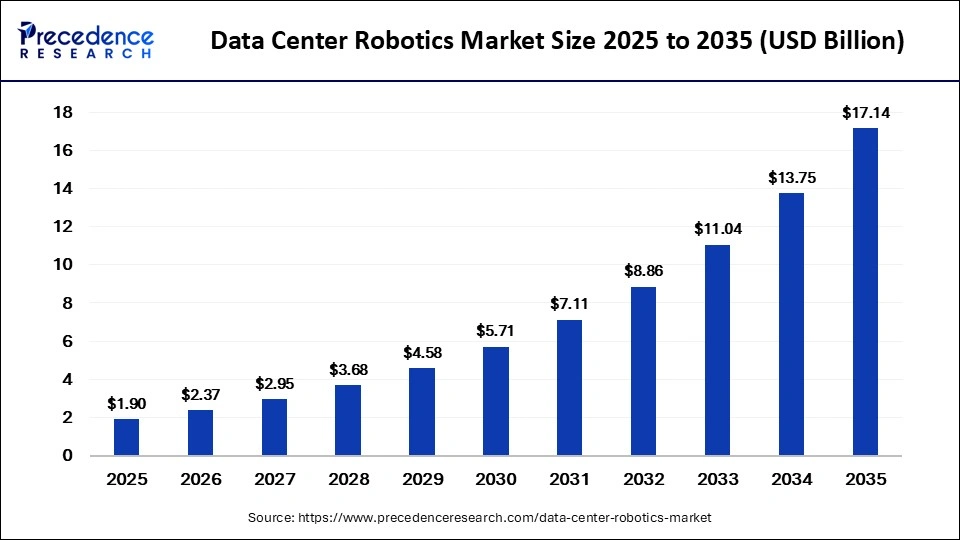
The market is projected to grow from $1.90 billion in 2025 to $2.37 billion in 2026, before reaching approximately $17.14 billion by 2035, according to Precedence Research. That represents a compound annual growth rate of 24.60% between 2026 and 2035.
The expansion reflects a broader shift in data center operations. As facilities add more servers, accelerators and increasingly complex cooling and power systems, operators are turning to robotic systems for inspection, material movement, maintenance, security and other repetitive tasks.
| Data Center Robotics Market | Figure |
|---|---|
| Market size, 2025 | $1.90 billion |
| Market size, 2026 | $2.37 billion |
| Projected market size, 2035 | $17.14 billion |
| CAGR, 2026–2035 | 24.60% |
| Largest region, 2025 | North America |
| Fastest-growing region | Asia Pacific |
AI and Hyperscale Expansion Drive Demand
The growth of AI workloads is increasing pressure on data center operators to manage larger and denser computing environments. Precedence Research identifies the expansion of hyperscale data centers and the shortage of skilled technicians as major factors supporting robotics adoption.
Robotic systems used in data centers combine autonomous mobility, machine vision, sensors and AI-based monitoring. They can perform tasks such as inspecting server racks, moving equipment and batteries, monitoring environmental conditions and supporting maintenance operations. AI can also enable multiple robotic systems to coordinate activities across large facilities.
The need for automation is particularly pronounced in hyperscale facilities, where thousands of racks and extensive physical infrastructure create a large operational footprint.
Hyperscale data centers accounted for 40% of the global data center robotics market in 2025, the largest share among application segments. Precedence Research expects that share to rise to 45% by 2035, with the segment projected to grow at a 28.5% CAGR.
Colocation facilities represented 30% of the market in 2025, followed by enterprise data centers at 18% and edge data centers at 12%.
Autonomous Robots Lead Deployment
Autonomous mobile robots (AMRs) represented the largest robot-type segment in 2025, accounting for 30% of the market. Their ability to move independently through large facilities makes them suitable for transporting spare parts and inventory, inspecting racks and moving batteries across different areas of a data center.
Automated guided vehicles (AGVs) accounted for another 20%, while inspection and surveillance robots held 18%. Robotic arms represented 17% and collaborative robots, or cobots, 15%.
| Robot Type | 2025 Market Share | 2035 Market Share |
|---|---|---|
| Autonomous mobile robots | 30% | 33% |
| Automated guided vehicles | 20% | 18% |
| Inspection & surveillance robots | 18% | 20% |
| Robotic arms | 17% | 15% |
| Collaborative robots | 15% | 14% |
The AMR segment is expected to maintain its leading position through 2035, with Precedence Research forecasting a 28.5% CAGR. Inspection and surveillance robots are projected to reach a 20% share by 2035.
Inspection Is the Largest Use Case
Inspection and monitoring was the largest functional segment in 2025, accounting for 28% of the market. Robots equipped with sensors and monitoring systems can identify overheating racks, airflow imbalances, coolant leaks and vibration anomalies, helping operators detect potential problems before they lead to equipment failures or downtime.
Rack and server handling followed with a 22% share and is expected to be the fastest-growing functional segment through 2035, with a projected CAGR of 27.5%.
Cleaning and maintenance accounted for 20%, while cable management and security and surveillance each represented 15%.
| Function | 2025 Share | 2035 Share | 2026–35 CAGR |
|---|---|---|---|
| Inspection & monitoring | 28% | 30% | 26.5% |
| Rack & server handling | 22% | 26% | 27.5% |
| Cleaning & maintenance | 20% | 18% | 22.5% |
| Cable management | 15% | 12% | 21.0% |
| Security & surveillance | 15% | 14% | 24.5% |
North America Leads, Asia Pacific Gains Ground
North America held the largest regional share at 42% in 2025, supported by its concentration of hyperscale data centers, colocation facilities and cloud infrastructure. The region’s data center robotics market was valued at approximately $798 million in 2025 and is projected to reach about $7.28 billion by 2035.
The US accounted for approximately $598.5 million of the North American market in 2025 and is projected to approach $5.50 billion by 2035.
Asia Pacific held a 25% share in 2025 and is expected to record the fastest growth through 2035. Rising investment in AI infrastructure, data centers and automation is supporting demand across the region.
High Costs Remain a Barrier
The market’s growth does not eliminate the economic and technical challenges associated with robotics deployment.
Precedence Research identifies high initial investment and integration costs as a major restraint. Deploying robotic systems can require spending on hardware, AI software, sensors and infrastructure modifications. These costs can make adoption more difficult for smaller operators and markets with tighter capital constraints.
Software, however, is expected to become an increasingly important part of the market. Hardware accounted for 48% of market revenue in 2025, while software held 32%. Precedence Research expects software to record the fastest growth among the component categories as operators adopt AI-based fleet management, analytics and automation platforms.
Companies active in the broader market include Siemens, Rockwell Automation (NYSE: ROK), ABB, Verizon (NYSE: VZ), Microsoft (Nasdaq: MSFT), Cisco Systems (Nasdaq: CSCO), Hewlett Packard Enterprise (NYSE: HPE), Equinix (Nasdaq: EQIX), Digital Realty (NYSE: DLR) and others.