


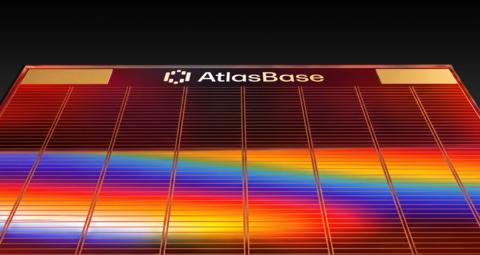
AtlasBase is introducing a molecular computing platform built around a DNA synthesis chip designed to bring synthetic DNA storage and computation closer to enterprise-scale deployment.
The company said its platform is powered by Thalia, a semiconductor-based DNA synthesis chip with 5.6 billion electrochemical synthesis sites. AtlasBase claims the architecture represents a 700-fold increase in synthesis scale compared with previously available DNA synthesis chips, addressing one of the major barriers to scaling molecular computing.
A DNA-Based Computing Layer
AtlasBase is positioning molecular computing as a complementary layer to conventional silicon infrastructure rather than a replacement for CPUs, GPUs or other traditional computing systems.
The platform uses synthetic DNA to store information and perform certain types of computation within the same molecular medium. This approach is intended to reduce the need to repeatedly move large datasets between storage and processing systems for workloads suited to molecular computation.
The company said the technology is aimed at the growing data and power requirements associated with artificial intelligence. As enterprises generate and retain increasingly large datasets, long-term storage and the infrastructure required to access and process that information are becoming more significant components of data center operations.
AtlasBase said its molecular platform is designed to address those requirements through a combination of DNA synthesis, molecular storage and DNA-based processing.
Thalia Chip at the Core
Thalia is the semiconductor component at the center of the platform. AtlasBase said the CMOS-based chip contains 5.6 billion electrochemical synthesis sites that can create synthetic DNA at substantially greater scale than previous DNA synthesis technologies.
| Feature | AtlasBase Platform |
|---|---|
| Core technology | Molecular computing using synthetic DNA |
| Synthesis chip | Thalia |
| Synthesis sites | 5.6 billion electrochemical sites |
| Claimed scale increase | 700x versus previous DNA synthesis chips |
| Storage medium | Synthetic DNA |
| Computing approach | In-memory molecular computation |
| Storage focus | Dense, long-term data preservation |
| Compute focus | Search and optimization workloads |
| Initial applications | Archives, digital preservation, optimization |
| Early access | Select partners and customers |
The company said Thalia is built using established semiconductor manufacturing technologies, allowing the architecture to scale through larger numbers of chips and systems. AtlasBase argues that this scalability is necessary to move DNA-based infrastructure from laboratory research toward enterprise and hyperscale data center environments.
The company was founded by a team with more than 15 years of experience in commercial DNA synthesis. Its approach combines semiconductor manufacturing with synthetic biology to address the challenge of producing DNA at the scale required for computing applications.
Storage and Computation
AtlasBase’s platform has two primary functions. Molecular data storage is intended for high-density, long-duration preservation of enterprise information, while molecular computing is designed for specialized workloads that can benefit from massively parallel processing.
The company is initially targeting applications including digital preservation, enterprise archives and complex optimization problems. Potential markets include media and entertainment, financial services, logistics, manufacturing, scientific research and resource exploration.
Entertainment is one area where AtlasBase sees an immediate application for molecular storage. Film and television studios maintain large libraries that must be preserved across decades, often requiring ongoing migration and maintenance as conventional storage technologies change.
Bill Baggelaar, former CTO of Sony Pictures Entertainment and co-author of the MovieLabs 2030 Vision, said molecular storage could provide a way to preserve creative assets over extended periods while reducing dependence on continual migration.
AtlasBase’s proposition extends beyond archival storage. The company is also developing the ability to perform computations directly against information stored in DNA, potentially allowing certain search and optimization workloads to be processed without conventional data movement.
From Research to Enterprise Infrastructure
DNA has been studied as an information-storage medium for more than three decades because of its information density and durability. Researchers have also explored DNA-based computation for specialized problems, although practical implementation at enterprise scale has remained a significant challenge.
Shuki Bruck, Gordon and Betty Moore Professor Emeritus at Caltech, said the next step is developing data-center-scale infrastructure capable of translating DNA storage and computation research into systems relevant to enterprise IT and AI workloads.
AtlasBase said its molecular computing platform is now entering an early commercial phase. The company is offering Early Access Programs for both Molecular Compute and Molecular Data Storage with selected partners and customers.
The initial deployments are expected to focus on archival and preservation workloads alongside computational problems where molecular processing could offer an advantage. The broader objective is to establish synthetic DNA as an additional data infrastructure layer for enterprises dealing with rapidly expanding data volumes.