

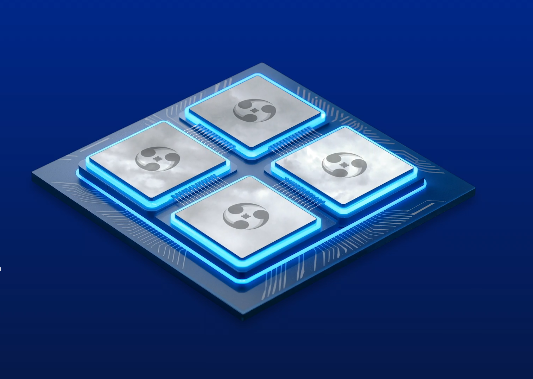
EdgeCortix has introduced RAIDEN, a scalable AI chiplet platform designed for high-performance artificial intelligence systems operating outside centralized data centers, where compute, memory, bandwidth and power constraints must be managed together.
The Japanese fabless semiconductor company said RAIDEN is designed for what it calls “Physical AI” applications, including robotics, autonomous systems, aerospace and defense equipment, intelligent manufacturing and edge AI infrastructure. The platform scales from a single compute die to a four-die configuration while maintaining a common hardware and software architecture.
At its maximum configuration, the RAIDEN X4 is architected to deliver up to 3.36 PFLOPS of FP4 AI compute, alongside up to 256GB of memory, 548GB/s of memory bandwidth and 1.54TB/s of aggregate die-to-die bandwidth.
The platform also supports up to 6.4Tb/s of chip-to-chip connectivity, allowing systems to scale beyond an individual multi-die package.
One Architecture Across Three Configurations
RAIDEN is built around a modular chiplet approach. EdgeCortix plans three configurations: the single-die X1, two-die X2 and four-die X4 flagship.
The X1 and X2 configurations will be detailed in subsequent phases of the launch program. The X4 represents the highest-performance configuration disclosed by the company so far.
All three versions use EdgeCortix’s DNA-X accelerator architecture and MERA software stack. The company said this common platform is intended to allow customers to move between configurations without changing their underlying AI architecture or rebuilding software investments.
| RAIDEN X4 specification | Up to |
|---|---|
| AI compute | 3.36 PFLOPS FP4 |
| Memory capacity | 256GB |
| Memory bandwidth | 548GB/s |
| Die-to-die bandwidth | 1.54TB/s |
| Chip-to-chip scale-out connectivity | 6.4Tb/s |
| Architecture | DNA-X |
| Software stack | MERA |
| Configuration | Four compute dies |
| Power management | Configurable power settings |
The architecture targets the “thick edge,” a category of computing in which substantial AI processing takes place close to machines, sensors and operational environments rather than in centralized cloud infrastructure.
This creates different requirements from conventional edge inference. Systems may need to process larger models, multiple workloads and real-time sensor data while operating within defined power, thermal and physical constraints.
DNA-X Expands Beyond AI Inference
At the core of RAIDEN is the latest version of EdgeCortix’s DNA-X architecture. The company said the architecture retains runtime-reconfigurable capabilities from earlier generations while adding microcode-programmable matrix and vector engines.
That design is intended to support workloads beyond conventional neural-network inference. EdgeCortix said perception, reasoning, application processing and control workloads can operate within the same platform.
For Physical AI systems, this distinction is significant because an AI pipeline may involve multiple stages between sensing an environment and taking an action. A robotic or autonomous system, for example, can require perception, model execution, decision-making and control within a constrained operating environment.
EdgeCortix said RAIDEN’s architecture is intended to reduce system-level compromises associated with moving models and data between internal and external memory, aggressive quantization and dividing AI and non-AI processing across separate computing systems.
The platform’s memory and bandwidth scale with the number of compute dies, allowing the architecture to accommodate larger workloads as systems move from one configuration to another.
MERA Software Links RAIDEN Generations
Software portability is another component of the platform.
The MERA software stack provides a common development and deployment environment across RAIDEN configurations, according to EdgeCortix. The company also said the software environment extends across product generations, allowing applications developed for its SAKURA-II platform to carry forward to RAIDEN.
This approach is intended to reduce the software migration requirements associated with moving to a higher-performance hardware configuration.
EdgeCortix Founder and CEO Dr. Sakyasingha Dasgupta said the company designed RAIDEN around the need for compute, memory, connectivity and software to scale together as Physical AI workloads evolve.
“Physical AI will not be won by simply building a faster accelerator,” Dasgupta said. “It requires a platform where compute, memory, bandwidth, connectivity and software scale together.”
Kawasaki, Unigen Among Early Customers
RAIDEN is entering the market with customer programs already secured, according to EdgeCortix.
Kawasaki Heavy Industries Ltd. has selected RAIDEN-based solutions for multiple next-generation AI-enabled aerospace and defense products, the company said. Such applications can require computing platforms to operate within demanding system constraints while supporting workloads that may evolve during long product lifecycles.
Unigen Corporation, a U.S.-based enterprise hardware provider, is developing RAIDEN-based server platforms. The work expands an existing collaboration between the companies involving SAKURA-II-powered modules and server systems, according to EdgeCortix.
The engagements span two different deployment models: AI processing integrated into intelligent machines and higher-performance computing infrastructure designed for on-premise or edge environments.
EdgeCortix said additional RAIDEN design wins, application categories and ecosystem partners will be disclosed as the program develops.
Sampling Starts in 2027
EdgeCortix expects customer sampling of RAIDEN to begin in early 2027, with volume production planned for the second half of 2027.
The company has also opened its RAIDEN Early Access Program for qualified customers and ecosystem partners. Participants can engage with EdgeCortix during the development phase and receive priority consideration for customer samples.
The launch places RAIDEN within a broader shift toward heterogeneous AI computing, where workloads are distributed across combinations of processors, accelerators, memory and specialized interconnects.