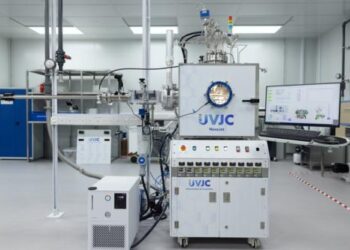



IQM Quantum Computers has deployed its IQM Radiance 54 quantum system at CINECA in Italy, marking a major step in Europe’s push to integrate quantum computing into national high-performance computing (HPC) infrastructure.
The system, installed at the DAMA Tecnopolo in Bologna, has been named “NOX” and is now live at the Italian Research Centre on High Performance Computing, Big Data, and Quantum Computing (ICSC). The deployment is designed to support advanced workloads in optimization, simulation, and machine learning, while enabling hybrid workflows that combine classical supercomputing with quantum processing.
The quantum system is being integrated with “Leonardo,” one of Europe’s most powerful supercomputers, creating a hybrid computing environment intended to support research institutions, universities, and industrial users. The goal is to provide a production-ready platform for experimenting with emerging quantum–classical computing models at scale.
IQM, which has announced a planned business combination with Real Asset Acquisition Corp (Nasdaq: RAAQ), expected to result in a public listing in mid-2026, said the installation represents a shift toward operational quantum infrastructure rather than experimental deployments.
“This installation is what Production Quantum means to us. Quantum computers you own, operate, and build value on,” said Sylwia de Weydenthal, Chief Commercial Officer of IQM Quantum Computers. She added that the deployment at CINECA marks a milestone for Italy and strengthens Europe’s broader quantum computing infrastructure strategy.
The installation is the first on-premises superconducting quantum computer at CINECA and the second IQM system deployed in Italy. IQM said it now operates on-premises quantum systems at four of the world’s top ten supercomputing centers and has sold 23 quantum computers globally, making it one of the most active vendors in the sector.
Italian officials and research leaders described the deployment as a strategic infrastructure asset rather than a standalone technology installation. The system is expected to support national research programs and accelerate the transfer of advanced computing capabilities into industrial and public sector applications.
Anna Maria Bernini, Italy’s Minister of University and Research, said the initiative reflects a broader European effort to build competitive national computing infrastructure capable of addressing scientific and technological challenges. She emphasized the importance of maintaining continuity in public research investments to strengthen long-term innovation capacity.
Antonio Zoccoli, President of ICSC and the National Institute for Nuclear Physics (INFN), highlighted the importance of digital sovereignty in a rapidly evolving global technology landscape. He noted that advanced computing infrastructure is increasingly critical for maintaining competitiveness amid geopolitical and energy uncertainties.
Francesco Ubertini, Vice-President of ICSC and President of CINECA, said the integration of quantum systems alongside HPC and AI workloads represents a new phase in Italy’s national computing strategy. He noted that the broader ecosystem, including additional systems such as SOL and LISA, is designed to support a wide range of applications from artificial intelligence to traditional scientific computing and emerging quantum workloads.
The IQM deployment reflects a growing trend across Europe toward hybrid computing environments that combine quantum processors with established supercomputing systems. These architectures are expected to play a key role in accelerating research in fields such as materials science, climate modeling, and complex optimization problems.
As IQM continues its global expansion strategy, the company said it aims to enable more institutions to adopt quantum computing as part of real-world production environments rather than isolated research platforms.