

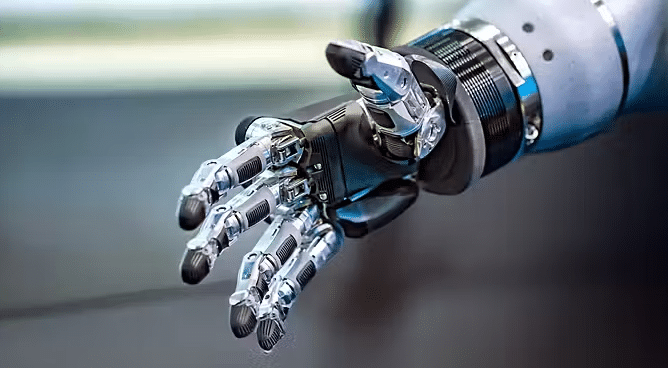
Infineon Technologies AG has expanded its collaboration with NVIDIA to accelerate the development and deployment of humanoid robots through advanced system architectures, digital twin technology, and enhanced safety and security frameworks.
The partnership builds on an earlier collaboration announced in August 2025 and focuses on enabling Physical AI—where robots can perceive, decide, and act in real-world environments. By combining Infineon’s expertise in semiconductors, including motor control, microcontrollers, power systems, and security, with NVIDIA’s AI, robotics, and simulation platforms, the companies aim to streamline the transition of humanoid robots from experimental prototypes to large-scale deployment.
A central component of the collaboration is the use of digital twins—virtual representations of Infineon’s smart actuators and sensors. These models are integrated into NVIDIA’s robotics simulation environments, such as Isaac Sim and Isaac Lab, allowing developers to test, validate, and refine robotic systems in realistic virtual settings before physical implementation. This approach helps identify potential design and integration issues early, reducing development time and minimizing risk.
Humanoid robots rely on a complex chain of semiconductor-driven functions, including sensing, data processing, actuation, connectivity, and energy management. Infineon’s contributions across these domains are expected to enhance real-time performance, improve system reliability, and support safe operation in environments designed for human interaction, such as factories, warehouses, and service settings.
The collaboration also emphasizes the development of a unified system architecture optimized for low latency, compact form factors, and high power density. Infineon’s hardware solutions will interface with NVIDIA’s advanced computing platforms, including Jetson-based systems, to enable efficient data processing and control at the edge. Additionally, the integration of post-quantum cryptography and secure hardware components aims to strengthen system-level protection against emerging cybersecurity threats.
Security and functional safety are key priorities in the initiative. Infineon will contribute hardware-based trusted platform modules and other security technologies to safeguard AI models, data, and system operations from edge devices to cloud environments. The companies will also collaborate within NVIDIA’s Halos AI Systems Inspection Lab to establish robust safety frameworks, supporting the development of certifiable systems for advanced robotics and autonomous applications.
With the global robotics market expanding rapidly, the collaboration underscores the growing importance of semiconductor innovation in enabling intelligent, autonomous systems. By leveraging digital twins, scalable architectures, and integrated security, Infineon and NVIDIA are positioning themselves to support the next generation of humanoid robots across industrial and commercial applications.