

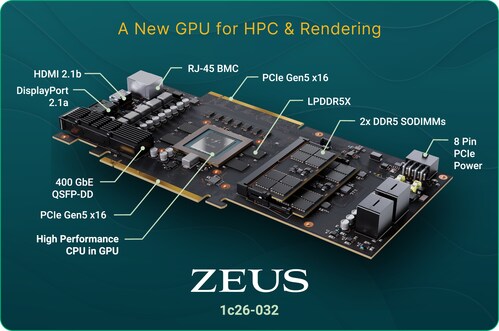
Bolt Graphics has completed the tape-out of its test chip for the Zeus GPU, marking a significant milestone in the development of its next-generation compute platform aimed at improving cost efficiency across high-performance computing (HPC), rendering, and emerging workloads.
The Zeus platform is designed to address a growing imbalance in the computing industry, where demand for processing power continues to accelerate but infrastructure costs remain a limiting factor. Traditional compute architectures have largely prioritized peak performance, often at the expense of cost efficiency, leaving several potential applications economically unviable.
“Compute demand is growing exponentially, but cost remains the limiting factor,” said Darwesh Singh, Founder and CEO/CTO of Bolt Graphics. “We believe the next generation of computing will be defined not just by performance but by efficiency. Our goal is to fundamentally change the economics of compute and become the default platform for next-generation workloads.”
Bolt Graphics is positioning Zeus as an alternative approach, focusing on performance-per-dollar rather than raw performance metrics. According to the company, the platform could reduce the total cost of compute by up to 17 times compared to existing architectures, potentially unlocking new use cases that were previously constrained by cost.
The test chip has been developed using Taiwan Semiconductor Manufacturing Company’s 12FFC process, with the broader Zeus architecture designed to scale to more advanced nodes, including 5nm. The platform integrates a custom GPU architecture with a full software stack, enabling a unified system capable of supporting multiple compute-intensive applications.
Industry observers note that the shift toward cost-optimized computing is gaining relevance as workloads such as simulations, real-time graphics, and artificial intelligence continue to expand. The Zeus platform’s architectural focus includes enabling advanced rendering techniques, such as path tracing, directly in silicon—an approach that could redefine graphics processing efficiency at scale.
Early indicators suggest growing market interest. Bolt Graphics reported a product pipeline exceeding $500 million and an early access program with over 14,000 participants, including enterprises, developers, and end users. Initial deployment is expected to focus on HPC and rendering workloads, segments that together represent a market exceeding $55 billion and remain heavily reliant on CPU-based compute.
The company plans to expand into gaming and AI workloads as the platform matures. Zeus is expected to enter production in the fourth quarter of 2027.