


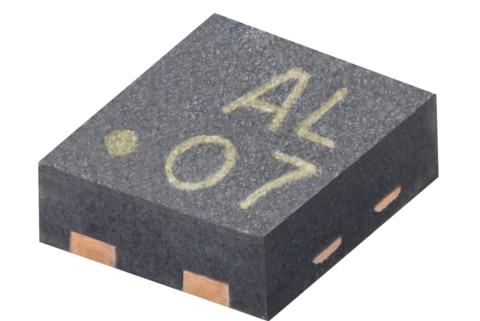
Murata Manufacturing Co., Ltd. (TOKYO: 6981; ISIN: JP3914400001) has announced the start of mass production for its latest anisotropic magnetoresistance (AMR) sensors, the MRMS166R and MRMS168R, targeting next-generation healthcare, wearable, and IoT devices where power efficiency and compact design are critical.
The launch marks a significant step in ultra-low power sensing technology, with the MRMS166R achieving an average current consumption of just 20 nA while operating at a supply voltage as low as 1.2 V. This positions it among the most energy-efficient AMR sensors currently available, particularly suited for battery-constrained applications powered by coin cell batteries.
AMR sensors function as solid-state magnetic switches, detecting the presence or absence of a magnetic field and converting it into an electrical signal. This enables system-level control of functions such as switching between active and sleep modes without relying on mechanical components. The result is enhanced durability, improved reliability, and the ability to support sealed and miniaturized device architectures.
Such functionality is increasingly vital across a range of applications. In healthcare, the sensors can be integrated into capsule endoscopes and wearable medical patches, where extended battery life and compactness are essential. In consumer electronics, they support use cases in AR glasses and wireless earbuds, while in IoT ecosystems, they enable efficient operation of smart locks and door detection systems.
Murata’s engineering approach focuses on addressing the inherent limitations of silver oxide coin batteries, which typically operate around 1.55 V and offer limited capacity. By redesigning the internal circuitry of its AMR sensors, the company has achieved stable low-voltage operation while minimizing standby power consumption. This enables devices to operate for over two years under typical usage conditions.
Both sensors are housed in a compact 1.0 × 1.0 × 0.4 mm package, optimized for space-constrained designs. While the MRMS166R emphasizes ultra-low power consumption, the MRMS168R offers higher output drive capability, supporting applications that require greater load current.
With this launch, Murata reinforces its focus on advancing sensor technologies that align with the evolving demands of low-power, high-performance electronic systems. The company indicated plans to further expand its AMR sensor portfolio, with continued emphasis on reducing power consumption and enabling longer operational lifecycles across emerging device categories.