

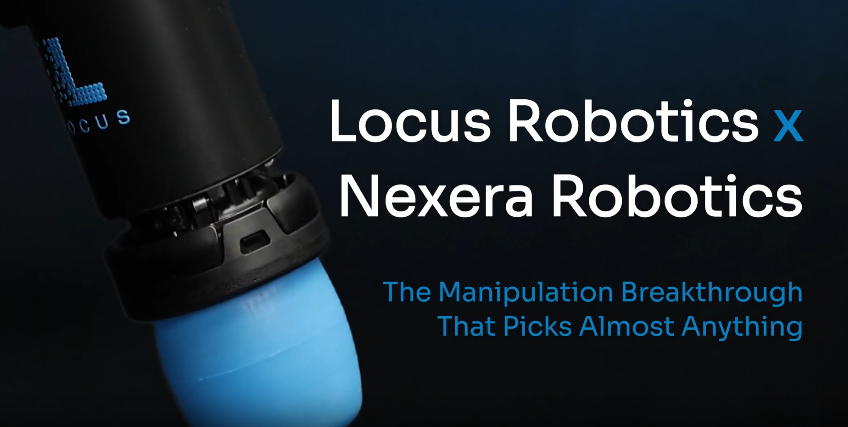
Locus Robotics has acquired Nexera Robotics in a move aimed at strengthening autonomous mobile manipulation capabilities for warehouse and fulfillment operations.
The acquisition brings Nexera’s patented NeuraGrasp end-effector technology into the Locus Robotics platform, expanding the company’s ability to automate robotic picking across a wider range of inventory types and warehouse conditions.
Locus Robotics said the integration will enhance its Locus Array platform, which focuses on autonomous Robots-to-Goods mobile picking systems designed for large-scale fulfillment environments.
The transaction reflects growing demand across logistics and e-commerce sectors for flexible warehouse automation systems capable of handling increasingly diverse inventory and fulfillment requirements.
Mobile manipulation technology is emerging as a key area of development within warehouse robotics. Unlike fixed automation infrastructure, mobile robotic systems are designed to move throughout fulfillment environments while adapting to changing inventory configurations and operational workflows.
According to Locus Robotics, one of the main challenges in warehouse automation is enabling robots to reliably pick and manipulate millions of stock keeping units (SKUs) with varying shapes, materials, packaging types, textures, and weights.
Nexera’s NeuraGrasp technology combines AI-driven grasping intelligence, computer vision, onboard sensing systems, and a patented soft membrane structure designed to dynamically adapt to different item characteristics.
The company said the technology has undergone development for more than five years across six generations of refinement and has been tested through tens of millions of robotic picks.
NeuraGrasp is designed to support handling of difficult inventory categories including porous textiles, loosely packaged goods, perforated polybags, irregular packaging, contoured products, delicate items, and products with inconsistent surfaces.
Rick Faulk, Chief Executive Officer of Locus Robotics, said AI-driven mobile manipulation represents one of the next major stages in warehouse robotics development.
He said the ability to grasp a broad range of SKU types with speed and precision is becoming increasingly important as fulfillment operations seek higher levels of automation.
Roy Belak, Chief Executive Officer of Nexera Robotics, said the company developed NeuraGrasp to address robotic manipulation challenges that have historically limited autonomous picking systems.
He added that joining Locus Robotics provides the scale and deployment infrastructure needed to bring the technology into high-volume fulfillment operations.
Locus Array was formally introduced at MODEX 2026, where it was named among the top three finalists for Best New Innovation. The platform is currently being deployed at customer sites, according to the company.
The acquisition is expected to expand the range of autonomous picking tasks that Locus Array can perform while increasing the overall addressable market for the company’s warehouse automation systems.
Locus Robotics said Nexera Robotics will continue operating as a wholly owned part of the company, with the entire Nexera leadership and engineering team joining Locus Robotics following the transaction.
The acquisition also strengthens Locus Robotics’ intellectual property portfolio in AI-driven robotic manipulation and end-effector technologies.
The companies did not disclose financial terms of the transaction.
Industry demand for warehouse robotics and fulfillment automation has accelerated in recent years as retailers, logistics providers, and manufacturers seek greater operational efficiency, faster order fulfillment, and reduced labor dependency.
AI-powered robotic picking systems are increasingly viewed as a critical technology for next-generation fulfillment centers, particularly as warehouses manage growing inventory complexity and higher throughput requirements.
Locus Robotics said integration of NeuraGrasp technology into the Locus Array platform is expected to begin immediately, with broader deployment planned in the coming months.