

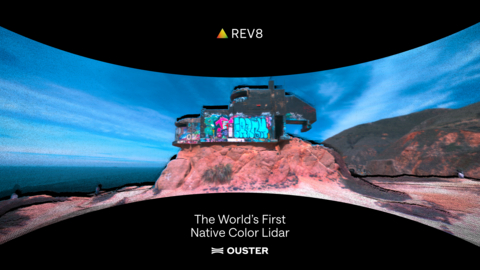
Ouster, Inc. (Nasdaq: OUST is moving deeper into multimodal sensing with a new native color lidar platform developed alongside FUJIFILM Corporation, as demand rises for richer perception systems in robotics and Physical AI applications.
The companies said the technology combines lidar depth sensing and color imaging within a single sensor architecture, eliminating the need for separate camera-lidar calibration workflows commonly used in autonomous and industrial systems.
The capability is being introduced through Ouster’s Rev8 OS family of digital lidar sensors. The platform integrates Fujifilm’s color science directly into Ouster’s L4 lidar silicon, enabling the sensor to generate native color point clouds with hardware-enabled HDR functionality.
The development reflects a broader shift in the sensing industry, where AI-driven systems increasingly require synchronized visual and spatial data for mapping, navigation, object recognition, and model training.
Conventional perception stacks typically combine lidar sensors with external cameras. While effective, these setups often require complex synchronization and calibration processes that can introduce alignment errors between color and depth data over time.
Ouster said the Rev8 platform addresses those limitations by processing both datasets through a shared optical and timing architecture on a single ASIC. The approach is intended to improve spatial and temporal alignment while reducing perception drift in long-duration operations.
Fujifilm contributed semiconductor-grade organic color filters and imaging expertise to the project. The companies said engineers worked to optimize spectral performance at the silicon level while preserving lidar signal integrity.
Yoshinori Taguchi said consistent and accurate color representation is becoming increasingly important for next-generation perception systems. He added that the technology could support future applications in robotics, AI, and advanced mapping.
Ouster said embedding color sensing directly into the lidar architecture allows the platform to capture high-fidelity color data while maintaining industrial-grade depth performance.
The integrated system is also expected to simplify hardware stacks in robotics and automation environments. By removing the need for separate camera systems and calibration pipelines, developers may be able to reduce hardware complexity and accelerate deployment timelines.
Potential use cases include generation of colorized 3D maps, AI training datasets with aligned spatial and visual data, enhanced object segmentation, and improved robotic navigation in dynamic environments.
Martin Millischer said the integration of Fujifilm’s color science into the lidar silicon enabled the company to combine accurate depth perception with realistic color capture in a single sensing platform.
The launch comes as robotics, autonomous systems, and industrial AI developers seek more advanced perception technologies capable of handling increasingly complex real-world environments. Industry players are also exploring ways to reduce system complexity while improving data quality for AI models and automation platforms.
Ouster said the Rev8 native color lidar platform is designed to support future Physical AI systems that require tightly aligned depth and imaging data for real-time environmental understanding.