

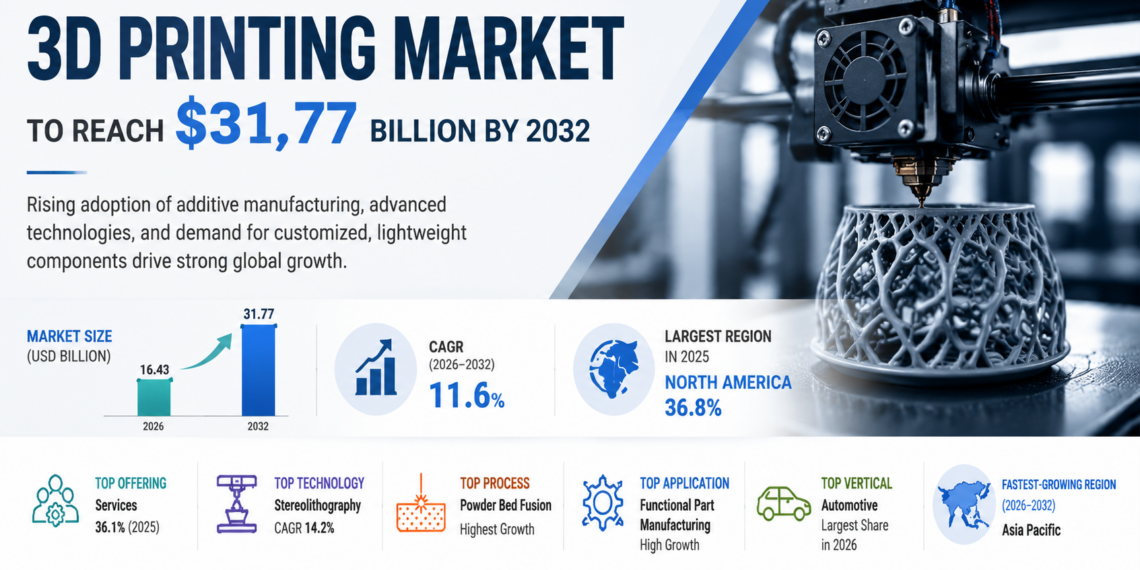
The global 3D printing market is projected to grow from $16.43 billion in 2026 to $31.77 billion by 2032, registering a compound annual growth rate (CAGR) of 11.6%, according to a report by MarketsandMarkets™.
The growth is being driven by increasing adoption of additive manufacturing across industries, rising demand for customised and lightweight components, and greater investment in digital manufacturing technologies. Companies across aerospace, automotive, healthcare, defence and consumer goods sectors are increasingly using 3D printing to improve production efficiency, reduce lead times and enable flexible manufacturing.
The report highlights that organisations are adopting advanced 3D printing technologies, including fused deposition modelling (FDM), selective laser sintering (SLS) and stereolithography (SLA), to support faster product development, design optimisation and precision manufacturing.
The shift towards distributed and localised manufacturing is also contributing to market growth. Manufacturers are increasingly using additive manufacturing to reduce dependence on complex global supply chains, optimise inventory management and produce components on demand.
By offering, services accounted for the largest share of the market, capturing 36.1% in 2025. The services segment is expected to continue expanding as companies increasingly outsource additive manufacturing activities, including rapid prototyping, engineering support, design optimisation and low-volume production.
Service providers are helping organisations adopt 3D printing without significant upfront investment in equipment and infrastructure. Their expertise in material selection, post-processing and quality assurance is making outsourced additive manufacturing an attractive option for industries seeking faster and more flexible production capabilities.
Among technologies, stereolithography is expected to register the highest growth rate during the forecast period, with a CAGR of 14.2%. The technology is gaining traction due to its ability to produce highly detailed components with improved surface quality, making it suitable for applications requiring precision.
The powder bed fusion process is also projected to witness significant growth, driven by increasing demand for high-performance components in industrial and aerospace applications.
The automotive sector is expected to hold the largest share of the 3D printing market in 2026. Automakers are adopting additive manufacturing for rapid prototyping, tooling, functional parts and lightweight component production.
The technology is supporting automotive manufacturers in reducing development timelines, improving material efficiency and creating complex geometries that are difficult to manufacture using conventional methods. The growing adoption of electric vehicles (EVs), lightweight vehicle designs and digital manufacturing processes is further accelerating the use of 3D printing in the automotive industry.
North America accounted for 36.8% of the global market share in 2025, supported by strong adoption of additive manufacturing in aerospace, defence, healthcare and industrial sectors. The region has witnessed increased investment in advanced manufacturing technologies and digital production capabilities.
Meanwhile, Asia Pacific is expected to be the fastest-growing market between 2026 and 2032. Countries including China, Japan, South Korea, Singapore and India are investing in additive manufacturing to strengthen industrial capabilities and accelerate Industry 4.0 adoption.
Growing investments in automotive, electronics, aerospace, healthcare and semiconductor manufacturing are expected to create new opportunities for 3D printing companies across the region.
Several global technology providers are competing in the market, including Stratasys Ltd. (Nasdaq: SSYS), HP Inc. (NYSE: HPQ), 3D Systems Corporation (NYSE: DDD), GE Aerospace (NYSE: GE), Materialise NV (Nasdaq: MTLS), Nano Dimension Ltd. (Nasdaq: NNDM), Renishaw plc (LSE: RSW), EOS GmbH, voxeljet AG and SLM Solutions.