


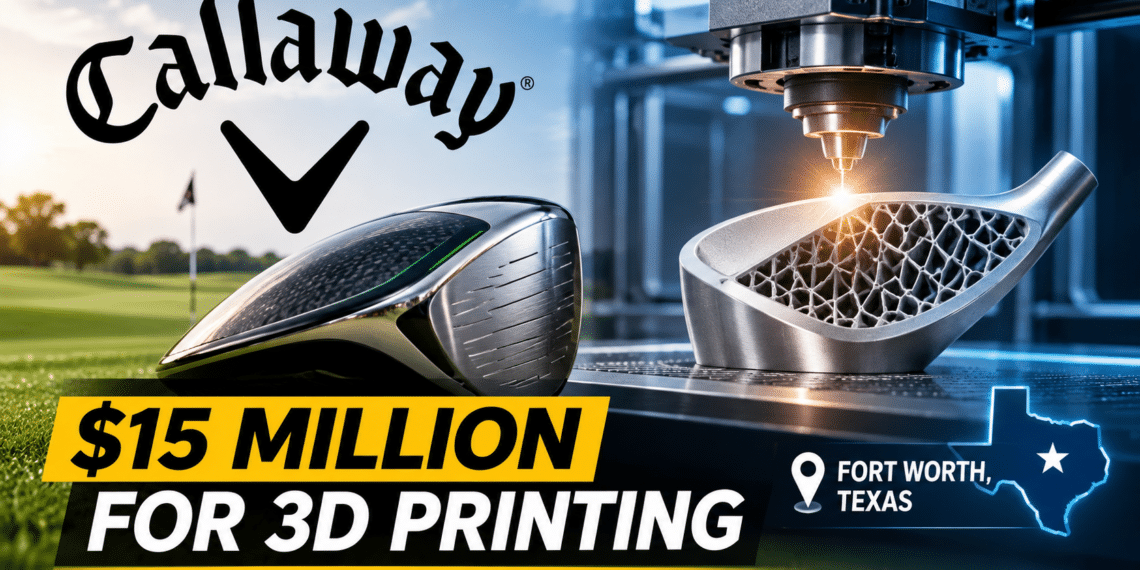
Callaway Golf Company (NYSE: CALY) is investing $15 million in an advanced 3D-printing facility in Fort Worth, Texas, as it looks to develop golf club designs that conventional manufacturing methods cannot readily produce. The facility is expected to become operational in mid-2027, with production intended to support part of the company’s U.S. product requirements from 2028.
Announced on November 6, the investment will expand Callaway’s titanium research, development and manufacturing capabilities. The facility will be located next to the company’s North America Distribution Center and will initially focus on custom titanium products.
Callaway Golf
The project marks a move to establish dedicated U.S. production capabilities for additive manufacturing, building on research and development work Callaway says has been underway for approximately seven years. The company has produced titanium prototypes and custom models internally since late 2022.
3D Printing Opens New Design Possibilities
The facility will give engineers greater scope to develop complex geometries and internal structures that are difficult or impossible to achieve through conventional manufacturing techniques, including casting, forging and machining.
Callaway President and CEO Chip Brewer described 3D printing as one of the most significant opportunities to advance golf club performance in decades. He said the investment would give engineers greater freedom to pursue designs that existing manufacturing methods cannot support.
Titanium is widely used in high-performance metalwoods, including drivers, fairway woods and hybrids, because of its combination of strength and low weight. Additive manufacturing can enable intricate internal structures, variable wall thicknesses and more complex shapes. These capabilities could give designers additional control over clubhead weight distribution and create new options for balancing performance characteristics.
However, the company has not disclosed specific performance targets or confirmed when 3D-printed components will appear in mainstream retail products.
Initial Production Focuses on Custom Products
Callaway expects the facility to begin supporting a portion of its U.S. product needs in 2028, initially through custom titanium products. The announcement does not establish a timeline for mass-market golf clubs using the technology.
The early focus suggests the company will use the facility to develop and manufacture specialized products while refining production processes. The ability to move from prototyping to dedicated manufacturing could also shorten development cycles and allow engineers to test more complex designs.
Scaling the technology will remain an important consideration. Additive manufacturing can offer design flexibility, but production costs, material efficiency and manufacturing consistency will influence whether the process can be extended to larger product volumes.
Investment Follows Higher Full-Year Outlook
The announcement came a day after Callaway reported third-quarter 2026 results and raised its full-year sales and adjusted EBITDA forecasts. Net sales for the quarter declined 5.6% year over year to $436.9 million, although the company said revenue and adjusted EBITDA exceeded expectations.
Callaway increased its 2026 net sales outlook to between $2.065 billion and $2.078 billion, from its previous range of $2.045 billion to $2.070 billion. Its adjusted EBITDA forecast rose to $272 million-$280 million, compared with the earlier estimate of $246 million-$260 million.
Callaway Golf Company+1
The Texas project adds a manufacturing and technology dimension to the company’s investment plans. Its commercial significance will depend on whether 3D-printed titanium components deliver measurable performance improvements and can be produced economically at scale.
For now, the $15 million commitment is primarily an investment in engineering capability. The first production milestone is expected in 2028, while broader adoption will depend on manufacturing costs, product testing and consumer demand.