

CesiumAstro has raised $730 million in a Series D financing round led by Janus Henderson, valuing the space communications company at more than $4.5 billion. The company also unveiled plans for Synchronicity, a 737-satellite constellation for commercial, sovereign and defense missions, following the start of on-orbit operations for its first satellite, Element-1.
The financing brings the total capital CesiumAstro has announced in 2026 to more than $1.2 billion. Alongside the equity round, the company secured $100 million in debt financing from the Export-Import Bank of the United States (EXIM) and JPMorgan. The proceeds will support technology development, US manufacturing expansion, next-generation spacecraft production, Synchronicity deployment and international growth.
The round also included Insight Partners, Sands Capital, Sumitomo Corporation of Americas, Woven Capital, Toyota’s growth fund, Incharge Capital, Magnetar, AV and NewSpace Capital.
The announcement marks a shift in CesiumAstro’s business model. The company, which develops communications equipment and complete spacecraft, now plans to build and operate its own satellite infrastructure. It intends to draw on an integrated portfolio spanning semiconductors, phased-array antennas, software-defined payloads, processors, spacecraft, mission software and user terminals.
Synchronicity targets commercial and defense communications
The planned Synchronicity network will comprise 737 satellites and use a dynamically managed, multi-beam, multi-frequency architecture. It is designed to support Ku-, Ka- and V-band communications, edge computing and multi-orbit operations.
Artificial intelligence will be integrated across the system to optimize network performance, allocate communications resources and adapt operations to changing mission requirements, according to the company. Its edge-computing capabilities are intended to process data closer to where it is generated, reducing reliance on terrestrial infrastructure and supporting applications that require low-latency responses.
CesiumAstro is positioning the constellation for commercial, sovereign and national security missions. Its architecture is designed to combine communications and computing capabilities within a single system, rather than rely on independently sourced components.
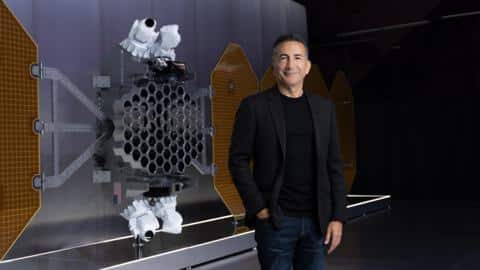
“Synchronicity is the culmination of the technology stack we have methodically built since CesiumAstro was founded,” said Shey Sabripour, the company’s founder and chief executive. He said CesiumAstro had designed the silicon, active phased arrays, payloads, processors, spacecraft, ground terminals and network as an integrated system.
The company did not disclose a deployment schedule for the 737 satellites, an expected service start date or the constellation’s planned orbital configuration.
Element-1 begins on-orbit operations
The constellation announcement follows the launch of Element-1 in October 2026 and the start of its on-orbit operations. The satellite combines CesiumAstro’s communications payloads, active phased-array technology, computing systems and spacecraft engineering.
The company describes the mission as a demonstration of technologies developed over nearly a decade. Element-1 is the first of eight planned spacecraft in the Element program. CesiumAstro said it has secured launches for the seven additional spacecraft, which are intended to support the next deployment phase.
The program is also intended to advance the company’s space-based edge-processing capabilities, allowing data to be processed closer to its source. The announcement did not provide launch dates or operational details for the remaining seven spacecraft.
Acquisitions broaden technology portfolio
CesiumAstro said three acquisitions over the past 12 months have expanded its capabilities across semiconductors, mission software and artificial intelligence.
The acquisition of Jariet Technologies adds millimeter-wave radio-frequency system-on-chip technology, mixed-signal semiconductors, digital signal processing and digital beamforming capabilities. Jariet specializes in technologies for satellite communications, electronic warfare and radar systems.
The company also acquired 1Aardvark, which specializes in mission software, algorithms and systems engineering for national defense programs. CesiumAstro said the acquisition strengthens its ability to develop autonomous spacecraft operations and systems that can respond to changing conditions or disrupted connectivity.
Vidrovr, an AI company focused on real-time multimodal signal analysis, is the third addition. Its capabilities are expected to support radio-frequency optimization, autonomous satellite operations and reconfigurable edge computing across CesiumAstro’s space and defense platforms.
Together, the acquisitions are intended to give CesiumAstro greater control over the technologies used to design, manufacture and operate its systems.
$500 million Austin expansion planned
CesiumAstro is also increasing its manufacturing and engineering capacity. The company announced a $500 million investment over five years to expand its Austin-area headquarters, including the purchase of 270,000 square feet of advanced manufacturing space.
The expansion will support precision electronics and spacecraft manufacturing, engineering, integration and testing. CesiumAstro expects the investment to create 550 jobs and increase its Austin-area workforce to more than 1,000 employees by 2030.
Beyond Texas, the company said it is investing hundreds of millions of dollars in engineering, manufacturing and operations across the United States, with facilities in Colorado, California, Alabama, Florida and the Washington, D.C., area. It is also expanding operations in the United Kingdom, Germany, Switzerland, Taiwan, Singapore and Japan.
The additional capacity is intended to support production of communications and sensing systems, advanced computing technologies and spacecraft, as well as development of Synchronicity.
Sabripour said CesiumAstro had spent nearly a decade building its engineering capabilities, intellectual property and manufacturing infrastructure. Janus Henderson portfolio manager Aaron Schaechterle said the investment was made through the firm’s Ascent platform, which provides private-market capital to companies it believes can reshape their industries and potentially progress toward public markets.