


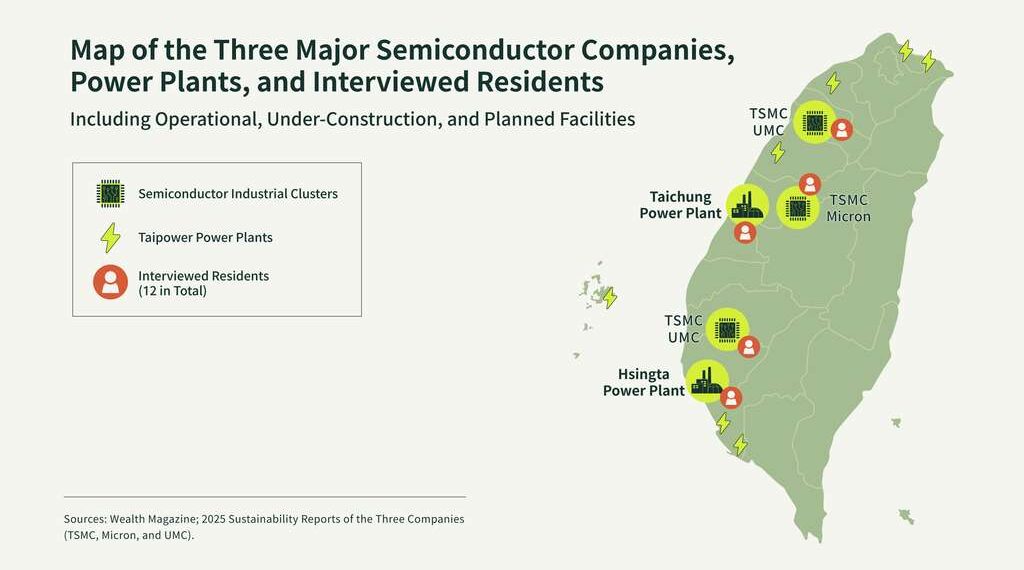
Taiwan’s three major semiconductor manufacturers could consume nearly 15% of the island’s projected electricity demand by 2030 as the expansion of artificial intelligence infrastructure drives chip production, according to a new Greenpeace Taiwan report. The study also warns that rising industrial water requirements could intensify competition with agriculture and put additional pressure on communities near manufacturing facilities.
The report, Visible Chips, Invisible Costs: The Hidden Price of AI and Semiconductor Expansion, estimates that the Taiwan operations of Taiwan Semiconductor Manufacturing Co. (NYSE: TSM), Micron Technology (NASDAQ: MU) and United Microelectronics Corp. (NYSE: UMC) could require a combined 49.8 billion kilowatt-hours (kWh) of purchased electricity annually by 2030. That would represent 15% of Taiwan’s projected total power demand, up from 32.4 billion kWh, or 11% of national demand, in 2025.
Their combined tap-water withdrawals could also reach approximately 191.7 million cubic meters by 2030, equivalent to about 8% of Taiwan’s projected residential water supply, the environmental organization said.
Released on November 10, the study examines the companies’ electricity and water consumption between 2022 and 2025, alongside projections for the end of the decade. It draws on corporate disclosures, government emissions data, estimated energy consumption and field interviews with residents in communities surrounding semiconductor facilities.
Greenpeace East Asia
Semiconductor Expansion Adds Pressure to Taiwan’s Power Grid
Taiwan is central to the global semiconductor supply chain, manufacturing more than 90% of the world’s most advanced chips, according to the report. Its importance has increased with demand for advanced processors and other components used in AI systems and data centers.
However, the growth in manufacturing capacity is increasing demand for electricity in an energy system that remains heavily dependent on fossil fuels. Greenpeace estimates that fossil fuels accounted for nearly 85% of Taiwan’s electricity generation in 2025, with natural gas contributing 48%.
The three companies’ combined external electricity consumption rose from 25.8 billion kWh in 2022 to 32.4 billion kWh in 2025. The projected increase to 49.8 billion kWh by 2030 reflects the expected expansion of semiconductor manufacturing and its associated infrastructure.
TSMC accounts for the largest share of the resource demand. The company represented approximately 80% of the three manufacturers’ combined grid electricity consumption and 72% of their tap-water withdrawals, according to Greenpeace. Its external electricity demand could reach 39.8 billion kWh by 2030 under the report’s scenario.
Between 2022 and 2025, TSMC added 6.1 billion kWh to its external power demand and increased municipal water use by 12 million cubic meters.
Water Demand Raises Concerns for Agriculture
The report identifies water availability as another growing constraint for Taiwan’s semiconductor sector. Combined tap-water withdrawals by TSMC, Micron and UMC increased from 134 million cubic meters in 2022 to 146.6 million cubic meters in 2025. Greenpeace projects that figure could rise to 191.7 million cubic meters by 2030.
The organization links industrial water demand to growing pressure on agricultural users, particularly during periods of limited rainfall. In March 2026, water rationing in the Toucian River basin in Hsinchu restricted agricultural irrigation during the rice-planting season, prompting protests from farmers over the allocation process.
Greenpeace also cited concerns from farmers in Houli District and Hsinchu City, where industrial water allocation policies have added uncertainty to agricultural operations. The report says irrigation restrictions during dry periods can threaten seasonal harvests and rural livelihoods.
Beyond water availability, the study highlights the impact of semiconductor facility expansion on nearby residential areas. Residents have reported construction noise, dust and increased heavy-vehicle traffic. A Greenpeace noise assessment near Micron’s facility in Taichung’s Houli District recorded peak levels of approximately 70 decibels.
Environmental and Public Health Costs
The report also draws attention to the health effects associated with electricity generation for Taiwan’s electronics manufacturing industry.
Citing a March 2026 study by the Centre for Research on Energy and Clean Air and Greenpeace, it estimates that air pollution linked to power generation for the sector could contribute to 90 premature deaths, 277 cases of childhood asthma and nearly 19,000 work absences annually by 2030 under a scenario in which renewable electricity procurement remains at 2023 levels. The associated health-related economic damage could approach $500 million annually.
CREA+1
These estimates concern the broader electronics manufacturing sector, rather than the three semiconductor companies alone.
Greenpeace Calls for Clean Energy and Reclaimed Water
Greenpeace is urging semiconductor manufacturers to commit to using 100% renewable electricity and 100% reclaimed water by 2030. It recommends that companies expand renewable energy procurement through direct power purchase agreements and self-generation, while increasing the use of recycled and reclaimed water to reduce reliance on municipal supplies.
The organization has also called for legally binding consultation with residents and farmers before factory expansions, along with public disclosure of environmental impact assessments, expansion plans and real-time monitoring data. It further recommends community investment in wastewater treatment, regional microgrids and agricultural water-efficiency infrastructure.
The report’s projections, however, are scenario-based rather than company-issued forecasts. For electricity, Greenpeace applies Taiwan Power Company’s projected 53.8% growth in semiconductor industry consumption between 2026 and 2030 to the companies’ 2025 external electricity use. Its water estimate applies a 1.5-times multiplier to 2023 withdrawals, based on projected growth in water use associated with data center-related chip manufacturing.
The electricity figures exclude self-generated power, while water estimates cover municipal tap-water withdrawals and exclude reclaimed, recycled and exchange water. Greenpeace also used estimates for some Micron and UMC facility-level consumption where direct disclosures were unavailable.